
In the 17th century, the emperor of India commissioned the Taj Mahal as a monument of breathtaking beauty to honor his late wife. History tells us that during the long years of construction, he became consumed with the details — the marble, the carvings, the symmetry. One day, while walking through the site, he tripped over a dusty, linen‑wrapped bundle blocking the path. Irritated, he ordered it thrown away.
Only later did he learn that the bundle was the casket containing his wife’s body.
In his obsession with the monument, he discarded the very person the monument was meant to honor.
That is what idolatry does.
The first commandment tells us who to worship.
The second commandment tells us how to worship.
God is not only concerned with exclusive loyalty — He is concerned with right worship.
What the Second Commandment Really Protects
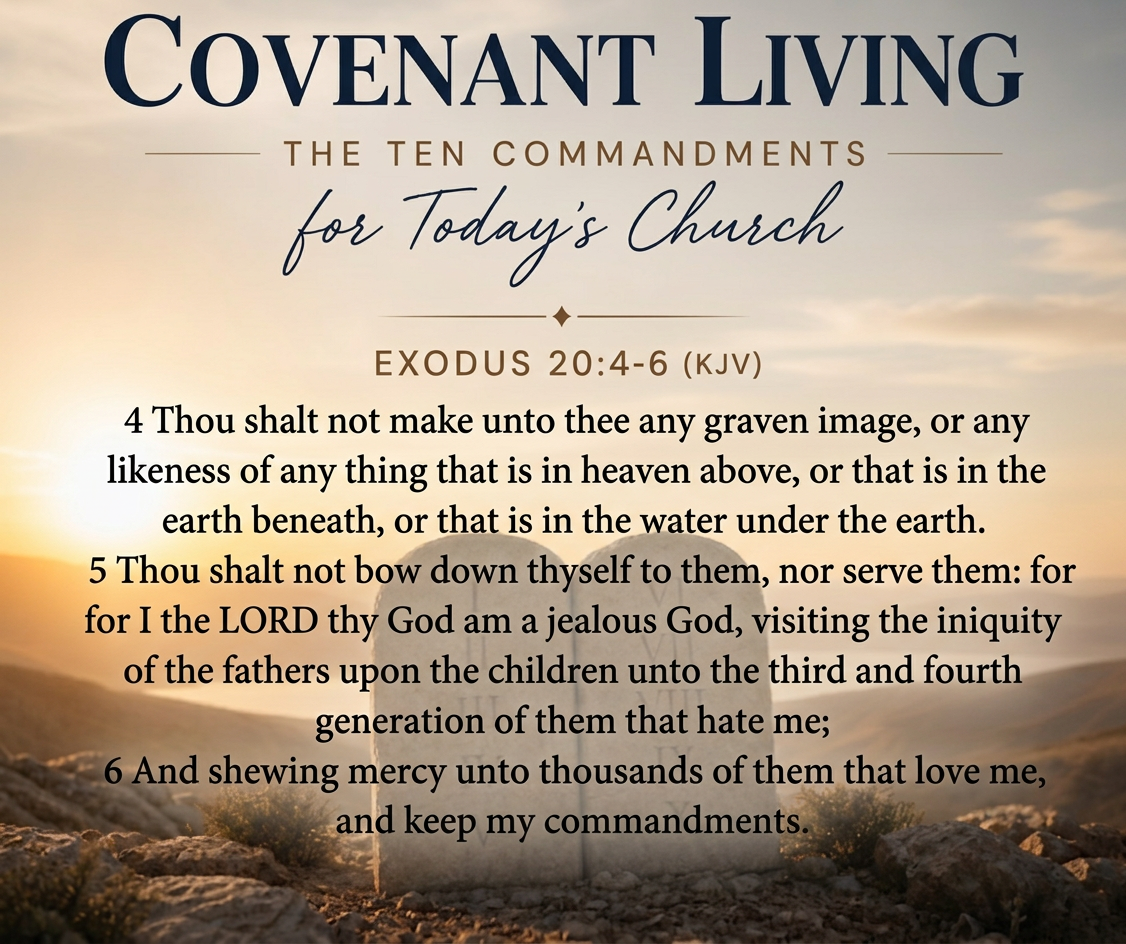
Exodus 20:4–6 is not simply about statues. Israel lived in a world filled with carved images, sacred objects, and physical representations of gods. But the danger was never just the object — it was the heart behind it.
The human heart is not only tempted to worship the wrong god — it is tempted to worship the right God in the wrong way.
- God Forbids Idols Because They Distort His Nature
“Thou shalt not make unto thee any graven image.”
Scripture is clear:
- God is a Spirit (John 4:24).
- He is invisible (1 Timothy 1:17).
- He is eternal (Psalm 90:2).
- He has no physical form (Deuteronomy 4:15–16).
Any physical representation shrinks Him. It reduces His glory. It reshapes Him into something manageable, predictable, and controllable.
Isaiah asks, “To whom then will ye liken God?” (Isaiah 40:18).
The answer: no one and nothing.
Psalm 115 says idols have mouths but cannot speak, eyes but cannot see, ears but cannot hear — and those who make them become like them.
Idols distort God’s nature, and in doing so, they distort ours.
- God Forbids Idols Because They Distort Our Worship
“Thou shalt not bow down thyself to them, nor serve them.”
Idols redirect worship away from the living God and toward created things. They redefine worship into ritual, superstition, or manipulation.
Think of Exodus 32. Israel made a golden calf and called it “a feast to the LORD.”
They used God’s name — but not God’s way.
Jesus sets the standard:
“They that worship Him must worship Him in spirit and in truth.” (John 4:24)
Right worship rests on four pillars:
- Christ alone — the true image of the invisible God (Colossians 1:15).
- Obedience — God rejects ritual without righteousness (Isaiah 1:11–17).
- A transformed life — worship as daily surrender (Romans 12:1).
- Heartfelt devotion — humility, sincerity, and love.
Idols replace inward devotion with outward substitutes.
- God Forbids Idols Because They Damage Generations
Idolatry creates patterns — priorities, values, desires — that children naturally imitate.
Scripture is clear:
“The soul that sinneth, it shall die.” (Ezekiel 18:20)
God is not punishing innocent children.
He is warning that idolatry becomes generational culture.
Paul teaches that idolatry leads to:
- darkened hearts
- futile minds
- corrupted desires (Romans 1:21–25)
Idols don’t just affect individuals — they affect households, communities, and generations.
- God Commands Right Worship Because He Is Jealous for Our Good
God’s jealousy is not insecurity — it is covenant love.
It is the jealousy of:
- a husband protecting his bride
- a father protecting his children
- a shepherd protecting his sheep
Paul echoes this:
“I am jealous over you with godly jealousy.” (2 Corinthians 11:2)
God desires our worship because He desires our good.
- God Promises Mercy to Those Who Worship Him Rightly
Idols destroy generations.
Right worship blesses generations.
God promises mercy, stability, identity, and strength to those who love Him and keep His commandments.
Right worship produces a distinct people —
a people marked by holiness, truth, and covenant love (1 Peter 2:9).
The New Covenant Fulfillment: Christ Destroys Idols in the Heart
Jesus does not abolish the second commandment — He intensifies it.
He is:
- the true image of the invisible God (Colossians 1:15)
- the radiance of the Father’s glory (Hebrews 1:3)
Through Christ, God gives us:
- a new heart
- new desires
- new worship
- new loyalty
- new identity
Paul says, “Ye turned to God from idols.” (1 Thessalonians 1:9)
Idols lose their power when Christ becomes our treasure.
The second commandment is fulfilled not by striving — but by abiding.
Knowing the Psalm vs. Knowing the Shepherd
A famous actor once recited Psalm 23 at a dinner party. His voice was flawless, his delivery perfect. The room erupted in applause.
Later, an elderly pastor recited the same Psalm. His voice cracked, his posture was frail — but when he finished, the room was silent, reverent, and full of tears.
The actor said,
“I know the Psalm.
But this man knows the Shepherd.”
That is the point of the second commandment.
Idols let us act.
Right worship makes us abide.
Idols let us perform.
Right worship makes us surrender.
Idols let us memorize the script.
Right worship makes us know the Shepherd.
Three Prayer Targets for the Heart
- Pray for God to reveal hidden idols
Comfort, control, approval, money, image, relationships, self — anything that takes God’s place. - Pray for a return to right worship
Worship in spirit and truth. - Pray for Christ to be the treasure of the heart
Idols lose their power when Christ becomes precious.


