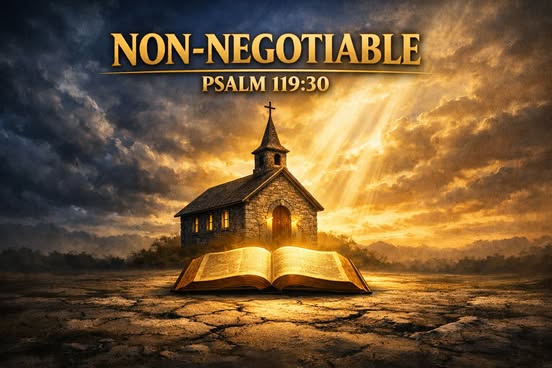
NON-NEGOTIABLE

Psalm 119:30 (KJV) “I have chosen the way of truth: thy judgments have I laid before me.” 

“Men do not drop into the right way by chance; they must choose it, and continue to choose it, or they will soon wander from it.” (Spurgeon) 

The true church, for a time, chose to adhere to and follow THE TRUTH, among the true church arose individuals who decided that there were aspects of THE TRUTH were optional and could be negotiated with and adjusted; in some cases, THE TRUTH was altogether forgotten. 

There is a call to us form the mouth of God, spend time with THE TRUTH, learn THE TRUTH, receive THE TRUTH, and be constantly CHANGE by THE TRUTH! Understanding that THE TRUTH is NON-NEGOTIABLE. 

We must spend time on the non-negotiables (of God’s Word) so that our lives may glorify God. – Dennis Rainey 

Non-negotiable means that something is fixed, absolute, not open for debate, bargaining, modification. It is essentially a line drawn in the sand. This line is bold, deep, and unavoidable. 

God has provided foundational truths, commandments, and doctrines in His Word that should never be compromised, changed, or ignored in the life of the believer or in the church. 

The gospel is not meant to bend to culture, convenience, or trends. As one writer put it: “We must conform to the Word of God, not try to conform the Word of God to us.” 

These things which are non-negotiable for the believer and for the church as a whole, fall into two categories; WHAT WE BELIEVE and HOW WE LIVE. 

  1. THEOLOGICAL NON-NEGOTIABLES (WHAT WE BELIEVE)– Theological non‑negotiables’ are the core doctrines God has revealed about Himself, salvation, and the Christian faith. 
  • They define the true God. If we get God wrong, everything else is wrong. 
    The Trinity, the deity of Christ, the nature of the Spirit — these are not optional details. They are the identity of God. 
  • They protect the purity of the gospel. A negotiable gospel becomes a powerless gospel. 
    If sin is minimized, grace is minimized. 
    If Christ is reduced, salvation is reduced. 
  • They anchor the church in truth. Culture shifts. Feelings shift. Opinions shift. 
    But God’s truth does not. 
    Theological non‑negotiables’ keep the church from drifting. 
  • They shape how we live. Doctrine is not abstract — it forms character, worship, holiness, and mission. 
    What we believe about God determines how we walk with God. 
  • They guard us from deception. Every false teaching begins by softening or questioning a core doctrine. 
    Theological non‑negotiables’ act as guardrails that keep believers safe. 
  1. The Triune Godhead – Matthew 28:19 “…baptizing them in the name of the Father, and of the Son, and of the Holy Ghost.” 

This is the clearest Trinitarian formula in Scripture — one Name, three Persons. 

  1. The Deity and Work of Jesus Christ – John 1:1 “In the beginning was the Word, and the Word was with God, and the Word was God.” 

This establishes Christ’s eternal deity and divine nature. 

  1. The Infallibility of the Word of God – 2 Timothy 3:16 “All scripture is given by inspiration of God…” 

This grounds all doctrine in God breathed revelation. 

  1. Humanity’s Sinful Nature – Romans 3:23 “For all have sinned, and come short of the glory of God.” 

This explains the universal human condition. 

  1. Salvation by Grace – Through Faith – Ephesians 2:8–9 “For by grace are ye saved through faith… not of works…” 

This shows God’s remedy for man’s condition. 

  1. The Promise of the Infilling of the Holy Ghost for Every Believer – Acts 2:39 “For the promise is unto you, and to your children, and to all that are afar off…” 

This affirms the Spirit’s empowerment for all believers. 

Theological non‑negotiables’ are the truths that define Christianity. If we surrender these, we surrender the faith itself. These are the truths we stand on, live by, and if necessary, die for. 

  1. LIFESTYLES NON-NEGOTIABLES (HOW WE LIVE)- Lifestyle non‑negotiables’ are the essential practices, attitudes, and behaviors that every believer must embrace in order to live out the gospel they profess. They are not suggestions, preferences, or personality‑based choices — they are the visible evidence of a transformed life. 
  • They are the fruit of genuine salvation. A changed heart produces a changed life. 
    Lifestyle non‑negotiables’ are not how we earn salvation; they are how salvation shows. 
  • They reveal the character of Christ in us. Love, repentance, holiness, faithfulness, prayer, and devotion to the Word are not human achievements; they are Christ’s life being formed in us. 
  • They distinguish believers from the world. Without lifestyle non‑negotiables’, Christianity becomes indistinguishable from culture. 
    Holiness, obedience, and discipleship mark us as God’s people. 
  • They protect the believer from drifting. A life without repentance, prayer, or the Word becomes spiritually vulnerable. 
    Lifestyle non‑negotiables’ keep the believer anchored and aligned. 
  • They demonstrate the gospel to others. People may debate doctrine, but they cannot deny a transformed life. 
    Lifestyle non‑negotiables’ make the invisible gospel visible. 
  • They keep the believer in fellowship with God. Prayer, worship, obedience, and the Word are not religious duties; they are relational lifelines. 
  1. Love for God and Others – Matthew 22:37–39 “Thou shalt love the Lord thy God… Thou shalt love thy neighbour as thyself.” 

Love is the foundation of all Christian living. 

  1. Repentance of Sins – Acts 3:19 “Repent ye therefore, and be converted…” 

Repentance is the believer’s first response to God’s love. 

  1. Obedience and Holiness – 1 Peter 1:15–16 “Be ye holy; for I am holy.” 

Holiness is the lifestyle of those who belong to God. 

  1. Faithfulness and Discipleship – Luke 9:23 “If any man will come after me, let him deny himself, and take up his cross daily, and follow me.” 

Discipleship is daily, consistent surrender. 

  1. Prayer and Worship – 1 Thessalonians 5:17 “Pray without ceasing.” 

Prayer and worship are the believer’s continual posture. 

  1. Keeping and Studying the Oracles of God – Psalm 119:11 “Thy word have I hid in mine heart, that I might not sin against thee.” 

The Word sustains, shapes, and sanctifies the believer. 

Lifestyle non-negotiable are the daily responses God expects from every believer. They are the habits, disciplines, and attitudes that flow from a heart changed by grace. Lifestyle non‑negotiables are the practices God uses to form Christ in us and reveal Christ through us. 

God’s non-negotiables are not burdens; they are blessings. They protect us, shape us, and keep us aligned with His heart. When we honor what God has declared non-negotiable, our lives become a testimony that truly glorifies Him. 

Everything God has declared non-negotiable is meant to protect your soul, anchor your faith, and shape you into the image of Christ. 

When we negotiate what God has made non-negotiable, we weaken our walk, we confuse our identity, and we drift from the very life God is trying to give us. 

Some people try to live with one foot on God’s side of the line and one foot on the world’s side. 

God is calling the church to come back into alignment with His design. To be what He has called us and ordained us to be. May we examine ourselves and seek His face; determining to surrender, once again, to His will. 

The choice is ours.

Choose the Living God, the merciful God, the God who changes lives and redeems your story. Stand where God stands. Surrender to what He has declared non‑negotiable; and watch Him shape your life into a testimony that truly glorifies Him.

HAVE A BLESSED SUNDAY AND REST OF YOUR WEEK!

A LOOK OF COMPASSION

We have all been given “looks”. Looks that span from intense affection all the way to intense rage.

One of the most moving looks is a look that says, “I know you have messed up, but I love you and forgive you.”

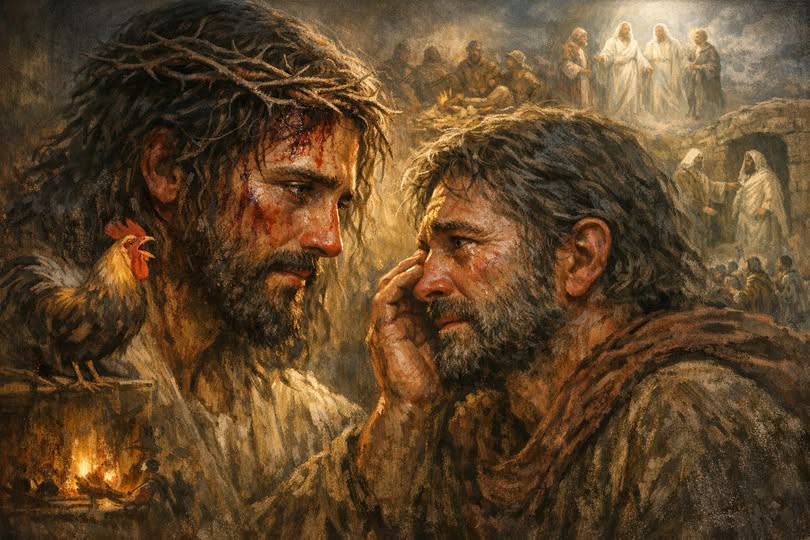
Luke 22:61And the Lord turned, and looked upon Peter. And Peter remembered the word of the Lord, how he had said unto him, Before the cock crow, thou shalt deny me thrice.

What a gut wrenching look that must have been. Peter bravely declaring, “I’ll die with you!” Now cowarding away and denying his Master.

I wonder what He saw when their eyes locked on each other? I wonder if Peter had flashbacks of Christs’ teachings or of the miracles? Maybe he heard in his mind the echo of Christ’s words as He said, “I came to seek and save that which is lost.” Perhaps he remembered when Christ blessed 5 loaves of bread and two fish; bringing about the feeding of 5,000+ people. I wonder if he remembered the power of being in the mount of transfiguration or when Christ told Lazarus to, “Come forth!”

I don’t know what went through Peter’s mind, but what I do know is that what he saw caused him to remember and to weep bitterly.

I believe what He saw was unconditional love. I believe what he saw was the way Christ saw him at that moment. I believe he saw what Christ knew he could be if he’d repent and be saved. I believe he saw the look that said, “You are why I’m giving my life willingly.” I believe at that moment, Peter saw the past, present, future, and how they all culminated for this moment right here and now.

The Messiah, the savior if the world was going to die for all mankind. He would take the sins of the past, present, and future upon His shoulders and cover them with every ounce of His blood.

And just to show Peter that His love was indeed unconditional. Christ told the women, “tell my disciples AND PETER.” Christ knew what Peter was feeling and wanted him to know that He still loved him and would forgive him.

What one look can convey! That look has been presented to each of us. My hope is that we all turn out the way Peter did…changed.

THE PRAYER MEETING

The prayer meeting is the litmus test of the church -Jim Cymbala

A litmus test reveals the true condition of something.

Prayer exposes the spiritual reality beneath the surface.

Why prayer is the test:

– You can grow a crowd without prayer.

You cannot grow a church without it.

– You can have programs without prayer.

You cannot have power without it.

– You can have music without prayer.

You cannot have anointing without it.

– You can have sermons without prayer.

You cannot have revival without it.

What the prayer meeting reveals

1. It reveals hunger

People come to what they value.

If the church values God’s presence, they pray.

If the church values convenience, they skip.

2. It reveals unity

Prayer meetings expose whether the church is a family or an audience.

3. It reveals dependence

A prayerless church is a church that believes it can manage without God.

4. It reveals spiritual temperature

You can measure the heat of a church by the heat of its prayer room.

One preacher stated, “The prayer closet is the Cinderella of the church.” The good thing about priorities is they can be rearranged again. May we become convicted and challenged to re-prioritize prayer again, understanding its necessity for the vitality of our lives.

GOD SEES THE HEART

In Scripture, “God knows the heart” is never a free pass

When the Bible says God knows the heart, it’s usually in contexts like:

– Judgment (1 Samuel 16:7; Jeremiah 17:10)

– Exposure of hidden motives (Hebrews 4:13)

– Condemnation of hypocrisy (Luke 16:15)

– A call to repentance (Psalm 139:23–24)

The biblical message is:

“God knows your heart—and that’s exactly why you should fear Him, repent, and obey.”

It is never:

“God knows your heart—so you’re fine doing whatever you want.”

“God and I have an understanding” is spiritual self-deception

That phrase is basically the modern version of Israel saying:

> “We will walk after our own devices, and we will every one do the imagination of his evil heart.” (Jeremiah 18:12)

People who say “God and I have an understanding” are really saying:

– “I know what God says, but I’m choosing my own path.”

– “I want the comfort of religion without the cost of obedience.”

– “I want God’s blessing without God’s boundaries.”

But Scripture is unambiguous:

God has never made a private deal with anyone that contradicts His revealed will.

Not once.

Every covenant God ever made was:

– Initiated by Him

– Defined by Him

– Bound by His character

– Consistent with His Word

God does not negotiate sin.

He does not tailor holiness to personal preference.

He does not rewrite righteousness to fit someone’s lifestyle.

God knows the heart—and the heart is the problem.

Jeremiah 17:9–10

Matthew 15:19

Romans 3:10–18

The heart is not a justification; it’s the indictment.

If anything, “God knows my heart” should make a person tremble, not relax.

What people mean is: “I want God on my terms.”

And that’s the oldest sin in the book.

Adam and Eve wanted:

– God’s presence

– God’s blessing

– God’s garden

…but their own authority.

Modern Christians often want:

– God’s forgiveness

– God’s protection

– God’s comfort

…but their own lifestyle.

It’s the same rebellion with a churchy vocabulary.

When people use these phrases, they’re not just avoiding obedience—they’re avoiding transformation. They’re insulating themselves from conviction. They’re creating a false peace.

And false peace is more dangerous than open rebellion because it feels spiritual while being spiritually deadly.

LET THIS MIND BE IN YOU…

Paul says, “Let this mind be in you, which was also in Christ Jesus” (Philippians 2:5), he isn’t talking about a single attitude. He’s describing the entire inner posture of Christ; the way He thought, chose, valued, and responded. Scripture gives us a surprisingly clear picture of what that “mind” looks like.

1. A Mind of Humility (Philippians 2:6–8)

Christ “made Himself of no reputation.”

He willingly laid aside His rights, His status, His glory.

What this means for us:

– We stop fighting for recognition.

– We choose servanthood over status.

– We embrace God’s will over personal comfort.

2. A Mind of Obedience (Philippians 2:8)

Jesus was “obedient unto death.”

Obedience wasn’t an action — it was His mindset.

What this means for us:

– Obedience becomes our default posture, not an occasional act.

– We obey even when it costs us.

– We trust the Father’s wisdom above our own.

3. A Mind of Compassion (Matthew 9:36)

“When He saw the multitudes, He was moved with compassion.”

What this means for us:

– We see people through God’s eyes.

– We respond to need instead of retreating from it.

– Compassion becomes a reflex, not a reaction.

4. A Mind Set on the Father’s Will (John 4:34; John 6:38)

“My meat is to do the will of Him that sent Me.”

“I came… not to do My own will.”

What this means for us:

– God’s will becomes our sustenance.

– We stop living by impulse and start living by assignment.

– We measure success by faithfulness, not outcomes.

5. A Mind of Meekness and Gentleness (Matthew 11:29)

“Learn of Me; for I am meek and lowly in heart.”

What this means for us:

– Strength under control.

– Responding gently even when provoked.

– Being approachable, teachable, and peaceable.

6. A Mind Anchored in Truth (John 17:17; Matthew 4:4)

Jesus lived by the Word, quoted the Word, trusted the Word.

What this means for us:

– Scripture becomes our filter for decisions.

– We reject lies, fear, and worldly thinking.

– We cultivate a mind renewed by truth (Romans 12:2).

7. A Mind of Forgiveness (Luke 23:34)

“Father, forgive them…”

What this means for us:

– We release offenses quickly.

– We refuse bitterness.

– We imitate the mercy we’ve received.

8. A Mind Focused on Others (Philippians 2:3–4)

“Look not every man on his own things…”

What this means for us:

– We shift from self-centered to others-centered.

– We serve without expecting return.

– We value people above convenience.

If God should go on STRIKE

How good it is that God above has never gone on strike,

Because he was not treated fair in things he didn’t like,

If only once he’d given up and said, “That’s it, I’m through!

“I’ve had enough of those on earth, so this is what I’ll do.

“I’ll give my orders to the sun — cut off the heat supply!

“And to the moon — give no more light, and run the oceans dry.

“Then just to make things really tough and put the pressure on,

“Turn off the vital oxygen till every breath is gone!”

You know he would be justified, if fairness was the game,

For no one has been more abused or met with more disdain

Than God, and yet he carries on, supplying you and me

With all the favors of his grace, and everything for free.

Men say they want a better deal, and so on strike they go,

But what a deal we’ve given God to whom all things we owe.

We don’t care whom we hurt to gain the things we like;

But what a mess we’d all be in, if God should go on strike.


This poem is a stirring reminder that God is ever faithful….even when we are not.

Lam 3:23  They are new every morning: great is thy faithfulness.

Lam 3:24  The LORD is my portion, saith my soul; therefore will I hope in him.

Lam 3:25  The LORD is good unto them that wait for him, to the soul that seeketh him.

The Lord is good and can be trusted!

THE GOD OF THE BREAKTHROUGH

Breakthrough begins when desperation becomes revelation; when you finally see what you cannot fix, cannot move, cannot change without God.

– You’ve reached the limit of your own strength – Psalm 73:26 My flesh and my heart fail….

– Something is resisting you that you cannot move – Psalm 18:17 “…My strong enemy…To strong for me…”

– You need divine intervention – Psalm 121:1-2 “I will lift up mine eyes…”

– You’re ready for change, even if it costs you – I will not let thee go, expect thou bless me.”

– Waiting has turned into longing – Psalm 42:1-2 “…O God, My soul thirsteth for God…”

– You believe there is more than what you’re experiencing – Habakkuk 3:2 “…O Lord, revive thy work…”

– You expect God to do something sudden, decisive, undeniable – Isaiah 64:1 “Oh that thou wouldest rend the heavens, that thou wouldest come down…”

In this passage, God reveals Himself by a name He has never used before: BAAL‑PERAZIM — “THE LORD OF THE BREAKTHROUGH.” We serve a God who can and will break in upon the scene and drive back the enemy, He will breakthrough the walls that block us from proceeding forward in Him. He will cause the mountain not just to tremble but to fall. He is the God of the breakthrough!

• Breakthrough doesn’t come to the passive.

• Breakthrough comes to the engaged.

• God does not bless disengagement; He empowers those who step onto the field.

Breakthrough comes to the believer who says:

• “I’m tired, but I’m still standing.”

• “I’m wounded, but I’m still fighting.”

• “I’m surrounded, but I’m not backing down.”

Desperation is what drives you to prayer, and prayer is what drives breakthrough into your situation.

Breakthrough doesn’t begin with action; it begins with seeking.

Prayer is where:

– Strategy is revealed – This was not the first time, nor would it be the last time that David inquired of the Lord. Every time David sought God’s direction, direction was given.

– Strength is renewed – David at Ziklag inquired of the Lord, encouraging Himself in His God. Our Savior often went into an isolated place to pray, why? To regain strength! Are you weary from the battle? Get into a place of prayer and pray consistently till you hear from heaven.

– The battle shifts – Prayer is a vital, active weapon in spiritual warfare that shifts battles from human limitation to divine power. It turns the struggle from a defensive position to an offensive one.

– Heaven enters the equation – As God hears your cry, He responds. The other part of the verse says, “Neither is His arm shortened that He cannot reach to save.”

Breakthrough is born in prayer.

Cry unto the God of the Breakthrough and watch Him do miraculous things!

FAITHFUL, STEADFAST, DEVOTED.

What causes a man or a woman to remain steadfast, faithful, and devoted?At its very core is a Person, not a principle. But that Person works in several deep, interlocking ways that explain why some men and women endure when others drift.

1. A continual return to the Cross

Steadfast believers don’t “move on” from the gospel. They revisit it. They rehearse it.

They remember.

– They remember what they were without Him; lost, dead, blind, enslaved. – They remember what they are with Him; redeemed, adopted, cleansed, empowered.

This rhythm of remembrance keeps the heart soft, grateful, and anchored. It’s why Paul repeatedly says, “I put you in remembrance…” and why Jesus gave the church communion: “Do this in remembrance of Me.”

The Cross is not just the starting line; it is the sustaining power.

2. A deep awareness of His faithfulness

People remain faithful because they are overwhelmed by His faithfulness.

– He keeps His promises.

– He finishes what He starts.

– He holds them when they cannot hold themselves.

– He proves Himself again and again in the quiet places of life.Faithfulness grows in the soil of being faithfully loved.

3. A calling that is not self‑Generated

A true call of God is not a hobby, a preference, or a phase. It is a divine assignment that grips the soul.

Those who endure do so because:

– They didn’t call themselves.

– They didn’t choose the mission; the mission chose them.

– They know they will answer to God for it.

When the call is from God, quitting feels impossible, not because of pride, but because of conviction.

4. A love for Christ that outweighs the cost

Every long‑term servant of God eventually discovers that ministry often gives little immediate return:

– Time poured out

– Energy drained

– Emotions stretched

– Finances sacrificed

– Recognition absent

And yet they stay. Why? Because love makes sacrifice feel like worship, not waste. Jesus becomes the treasure that makes every other cost feel small.

5. A vision of eternity that redefines “reward”

Steadfast believers are not living for applause here.

They are living for:

– “Well done, thou good and faithful servant.”

– Crowns that do not fade.

– Souls that will stand in glory because they were faithful.

– A kingdom that cannot be shaken.Eternal vision produces earthly endurance.

6. The empowering presence of the Holy Spirit

No one remains steadfast by grit alone. The Spirit strengthens what human resolve cannot sustain.

He:

– Renews the inner man

– Rekindles passion

– Convicts, comforts, and corrects

– Produces fruit that human effort cannot manufacture

Steadfastness is not a personality trait—it is a work of the Spirit.

7. A gratitude that never grows old

Gratitude is fuel. Gratitude is fire. Gratitude is glue.A grateful believer is a steadfast believer.

#FollowerofChrist#faithfulness#Steadfastness#Devotion#gratitude#KingdomOfGod

The Eternal Danger of Suicide

For many years I heard the statement, “Suicide will send someone to hell.” Yet every time I searched Scripture, I couldn’t find a verse that said this verbatim. What I did find—especially while studying the book of Job in 2024—was something far more revealing and spiritually sobering.

1. Scripture affirms the sacredness of lifeThe Bible grounds human value in the image of God. Passages like Genesis 2, Psalm 139:13–17, and Jeremiah 1:5 remind us that life is not random, accidental, or disposable. It is God‑breathed, God‑crafted, and God‑purposed.Because of this, taking life—whether another’s or one’s own—is an assault on God’s image and authority.

2. Scripture exposes Satan’s agendaJesus describes Satan’s mission clearly: Kill. Steal. Destroy. (John 10:10)Peter adds that he prowls like a roaring lion, seeking someone to devour—body, mind, and spirit.Satan cannot create life. He cannot redeem life. He cannot restore life. So he seeks to end life or convince people to end their own.Suicidal thoughts are never spiritually neutral. They are always a battlefield.

3. God alone determines the boundaries of lifeIn Job, Satan is explicitly forbidden to take Job’s life. God alone holds the keys of life and death. He determines beginnings and endings, purposes and seasons.Suicide is an attempt to seize a divine prerogative.

4. Job’s wife: the closest biblical picture of suicide encouragementThis moment is often overlooked.Job’s wife says: “Curse God and die.”This is not merely despair—it is a theological act:- Reject God – Abandon faith – End your life Satan cannot kill Job, but he can pressure Job to kill himself. Job’s wife becomes the mouthpiece for that temptation.This is the spiritual anatomy of suicide: Despair + accusation + hopelessness + self‑destruction.

5. Suicide in Scripture is consistently tied to rebellion or despairEvery suicide in the Bible is connected to spiritual darkness:- Saul – Ahithophel – Zimri – Judas Not one example is of a faithful believer acting in trust or hope.

6. So does suicide automatically send someone to hell?Here is the careful, biblical answer:Scripture does NOT say:“Suicide = automatic damnation.”Scripture DOES show:- Suicide flows from spiritual darkness, deception, or rebellion. – Suicide aligns with Satan’s agenda, not God’s. – Suicide is never portrayed as an act of faith. – Suicide is spiritually dangerous because it is the final act of hopelessness—unless God intervenes.We cannot declare the eternal fate of any individual. But we can declare the eternal danger of the act.

7. The pastoral truthGod’s mercy is greater than our darkest moment. But suicide is never the act of a heart resting in God.So we preach:- Hope – Courage – Repentance – Faith – God’s timing, not our own

8. A final wordSuicide is not just a mental battle. It is a spiritual one. And Scripture calls us to choose life, choose hope, and cling to the God who restores and redeems.

Praise, Unity, and the Presence of God

Individual unity with God creates unity in the church body. When we praise the God in unity, it creates an atmosphere that He inhabits. The result is radical manifestations of His power in and through His people.

Hebrews 2:4 KJV — God also bearing them witness, both with signs and wonders, and with divers miracles, and gifts of the Holy Ghost, according to his own will?

Mark 16:20 KJV — And they went forth, and preached every where, the Lord working with them, and confirming the word with signs following. Amen.