NO OTHER GODS: WHY THE FIRST COMMANDMENT STILL SPEAKS TO TODAY’S CHURCH

The first commandment isn’t merely an ancient rule carved into stone; it is the blazing heartbeat of covenant life. Before God ever tells His people what to do, He tells them who He is — “I am the LORD thy God, which have brought thee out…” That declaration frames everything that follows.

The Human Heart: An Idol Factory
In Israel’s day, Baal promised prosperity and Ashtoreth promised pleasure. Today the names have changed, but the idols haven’t. We still chase the same false gods — only now they come disguised as achievement, comfort, relationships, entertainment, money, or self.

The human heart, as one writer said, is like an idol factory. It never stops producing substitutes. The first commandment confronts that factory head‑on.

What “No Other Gods” Really Means
The commandment isn’t simply about removing idols; it’s about ordering the heart. God refuses to be added to our already‑busy lives. He demands — and deserves — the center.

Every sin begins with a misplaced god.
Every act of obedience begins with a rightly‑ordered heart.

Jesus begins with the heart: Seek ye first the kingdom of God
Paul begins with the heart: Set your affection on things above

The first commandment is about relationship, loyalty, and love toward the God who rescues.


GOD DECLARES HIS EXCLUSIVE CLAIM
“Thou shalt have no other gods before Me.”

This isn’t insecurity; it’s reality. There are no other gods — only illusions, imposters, and idols.

Scripture refuses to soften idolatry:

  • Flee from idolatry — run, don’t negotiate.
  • Idolatry keeps people from inheriting the kingdom
  • Idolatry is a work of the flesh
  • Idolatry belongs to the old life
  • Unrepentant idolatry destroys witness and fellowship

Why does God start here?
Because idolatry destroys witness, corrupts fellowship, and poisons holiness. It is loving, trusting, or obeying something more than God.

What This Commandment Reveals

  • God’s exclusivity — He alone is Creator, Redeemer, Sustainer.
  • God’s covenant love — “I am the LORD your God.”
  • God’s rightful authority — He rescued Israel; He owns Israel.

GOD EMPOWERS US TO OBEY THROUGH THE SPIRIT
The Old Covenant revealed the standard.
The New Covenant provides the power.

The Spirit gives:

  • New desires — a heart that wants God.
  • New strength — power to obey.
  • New loyalty — Christ formed within us.
  • New worship — worship that is real.

Paul teaches that idols lose their power when Christ becomes our treasure:

  • “I count all things loss… that I may win Christ.”
  • “Walk in the Spirit, and ye shall not fulfill the lust of the flesh.”

The first commandment is impossible without the Spirit — and becomes inevitable with Him.


GOD USES OUR LOYALTY AS A WITNESS
When God’s people worship God alone, the world sees something different.

Exclusive worship produces:

  • Distinct identity — a people set apart.
  • Visible holiness — light that shines.
  • Compelling witness — love that proves Christ.
  • True freedom — freedom from false masters.

The early church’s power came from exclusive loyalty to Christ. They had no other gods — not Caesar, not culture, not comfort. The world saw Christ because the church worshiped Christ alone.


A CALL TO RETURN TO YOUR FIRST LOVE
Sermons like this are divine invitations — a call back to the God who rescues.

Maybe something has taken God’s place.
Maybe a substitute has stolen your affection.
Maybe a false god has promised what only the true God can give.
Maybe you’ve never served Him at all.

Hear the voice of the Rescuer again:
“I am the LORD your God, who brought you out…”

He is still bringing people out:

  • Out of bondage
  • Out of fear
  • Out of idols
  • Out of substitutes
  • Out of the Egypts we create for ourselves

The invitation is simple:
Come to the Lord your God. Return to your first love.

Covenant Living: The Ten Commandments for Today’s Church – Grace Before Law

The opening lines of Exodus 20 are easy to rush past, but they are the doorway into everything that follows. Before God gives a single command, He gives a reminder — a rescue — a relationship.

“I am the LORD thy God, which have brought thee out of the land of Egypt, out of the house of bondage.” (Ex. 20:2)

That is where covenant living begins. Not with legalism. Not with pressure. Not with performance. With grace.


The Ten Commandments Begin With Rescue
Before God tells His people how to live, He tells them who He is. He anchors obedience in identity, relationship, and presence. He rescues first, then instructs. He frees, then forms.

As Morgan beautifully observed, God didn’t hand Israel a list of laws while they were still slaves, promising freedom if they obeyed. He brought them out — then taught them how to live free.

This matters for today’s church. We cannot understand the commandments unless we first understand the heart behind them.


God’s Law Reveals God’s Heart
When God speaks the commandments, He is not a distant judge handing down regulations. He begins with relationship:

“I am the LORD your God…”

Before He commands, He connects. The law flows out of His character — His holiness, His goodness, His desire for relationship.

  • God’s holiness — Leviticus 11:45
    His holiness is not cold; it is beautiful. The commandments show what holiness looks like in everyday life: worship, speech, relationships, priorities.
  • God’s goodness — Psalm 19:7–9
    Every command protects something precious: worship, marriage, truth, life, community.
  • God’s covenant love — Exodus 20:2
    The law is not a contract; it is a covenant. God says, “You belong to Me.”

The commandments are rooted in love — like a father whose rules preserve the joy of his children.


God’s Law Restores God’s People
Sin doesn’t just break rules — it breaks people. It fractures families, communities, identity. God’s law is His gracious blueprint for putting broken things back together.

  • Reordering our lives — Psalm 119:105
    God’s Word puts first things first.
  • Protecting us from self‑destruction — Psalm 119:9
    Idolatry destroys worship.
    Adultery destroys families.
    Theft destroys trust.
    Coveting destroys contentment.
  • Shaping a distinct people — Deuteronomy 10:13
    God’s commands are “for your good.” Holiness is meant to make God’s people shine.

The commandments are not shackles — they are safeguards. They are part of God’s restoration project.


God’s Law Leads Us to God’s Son
The law reveals God’s standard — and our inability to meet it. It is a mirror that exposes our sin and a tutor that leads us to Christ.

  • Shows our sin — Romans 3:20
  • Shows our inability — Galatians 3:24
  • Shows our Savior — Matthew 5:17

Jesus didn’t abolish the law — He fulfilled it. Perfectly. Sacrificially. Victoriously.

The commandments are not a ladder we climb to reach God; they are a spotlight showing our need for Jesus.


God’s Law Empowers God’s Mission
Obedience is never merely private — it is missional. A holy people display a holy God.

  • Holiness as witness — 1 Peter 2:9–12
  • Obedience that shines — Matthew 5:16
  • Love as apologetic — John 13:35

The world sees God through God’s people.


The commandments are not God’s way of keeping people out — they are God’s way of bringing people close. They reveal His heart, His goodness, His holiness, His desire for relationship, and our need for Jesus.

Maybe your life feels out of order.
Maybe sin has broken something in you — your peace, your home, your confidence.
Maybe you’ve been trying to obey God without abiding in God.

Hear His voice again:

“I am the LORD your God, who brought you out…”

He is still the God who brings people out — out of bondage, shame, fear, sin, and the “Egypts” we create for ourselves.

Before we learn the commandments, let’s meet the God who gives them.
Before we talk about obedience, let’s return to relationship.
Before we walk in holiness, let’s rest in grace.

Walking in the Light: Why Healthy Churches Are Not Cults

Every church, in every generation, will be misunderstood by someone. That’s not new. What matters most is that we continue to walk in the light, love people well, and stay faithful to the Gospel.

As ministers of the Gospel, our calling is simple and sacred:
to teach the Word openly,
to lead worship toward God and not ourselves,
and to welcome people sincerely — especially when they’re hurting, confused, or wrestling through life.

We don’t control people; we care for them.
We don’t isolate people; we disciple them.
We don’t pressure people; we point them to Jesus.

People are free to come, and while we are always saddened when they leave, they are free to go. That freedom is a mark of the true church.


Why Discernment Matters

From time to time, it becomes necessary to teach on spiritual discernment — including how to recognize unhealthy religious environments. Scripture warns about false teachers, abusive shepherds, and deceptive movements. Sociologists and religious scholars have also identified consistent traits that define cultic systems.

Below is a clear, accessible outline for readers who may be unfamiliar with these dynamics.


Common Traits of a Cult

  1. Authoritarian Leadership
    The Charismatic Figure: Everything revolves around one dominant leader claiming special revelation or insight.
    No Accountability: Their authority is absolute; no meaningful checks, balances, or external review exist.

  1. Coercive Control & Mind Manipulation
    Discouraging Critical Thinking: Questions, doubts, or dissent are punished.
    Behavioral Dictation: Leadership controls personal choices — dating, living arrangements, finances.
    Psychological Techniques: Intense chanting, rigid meditation, or exhausting routines suppress individuality.

  1. Isolation & Elitism
    Us vs. Them Mentality: The outside world is portrayed as dangerous or corrupt.
    Severing Ties: Members are pressured to cut off family and friends.
    Exclusivity: The group claims to be the only source of truth or salvation.

  1. Exploitation
    Financial Demands: Members surrender assets or meet unreasonable giving requirements.
    Labor Abuse: Exhausting work schedules benefit the leader or organization, not the individual.

Marks of the True Church

The true church is subject to one thing only: the Word of God.
Christ is our Master. His Word is our authority.

Healthy churches understand:

  • Leaders are accountable — before God and before people.
  • Integrity forms testimony: We shape people’s understanding of God by the way we live.
  • Favor flows from faithfulness: Scripture repeatedly says God’s people “found favor with both God and man.”
    Their obedience to God produced visible integrity before others.

This is the opposite of cultic behavior. Cults hide. The church shines.


A Non‑Obvious but Crucial Distinction

One of the clearest differences between a cult and the true church is how they handle weakness.

  • Cults punish weakness.
  • Christ welcomes weakness.
  • Cults demand perfection.
  • Christ forms disciples through grace, truth, and patient transformation.

A church that embraces broken people is not a cult — it is a hospital.

A LOOK OF COMPASSION

We have all been given “looks”. Looks that span from intense affection all the way to intense rage.

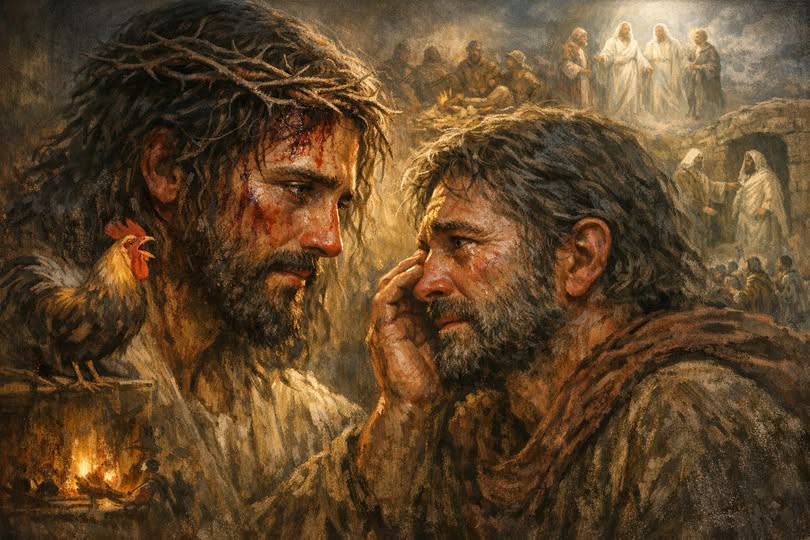
One of the most moving looks is a look that says, “I know you have messed up, but I love you and forgive you.”

Luke 22:61And the Lord turned, and looked upon Peter. And Peter remembered the word of the Lord, how he had said unto him, Before the cock crow, thou shalt deny me thrice.

What a gut wrenching look that must have been. Peter bravely declaring, “I’ll die with you!” Now cowarding away and denying his Master.

I wonder what He saw when their eyes locked on each other? I wonder if Peter had flashbacks of Christs’ teachings or of the miracles? Maybe he heard in his mind the echo of Christ’s words as He said, “I came to seek and save that which is lost.” Perhaps he remembered when Christ blessed 5 loaves of bread and two fish; bringing about the feeding of 5,000+ people. I wonder if he remembered the power of being in the mount of transfiguration or when Christ told Lazarus to, “Come forth!”

I don’t know what went through Peter’s mind, but what I do know is that what he saw caused him to remember and to weep bitterly.

I believe what He saw was unconditional love. I believe what he saw was the way Christ saw him at that moment. I believe he saw what Christ knew he could be if he’d repent and be saved. I believe he saw the look that said, “You are why I’m giving my life willingly.” I believe at that moment, Peter saw the past, present, future, and how they all culminated for this moment right here and now.

The Messiah, the savior if the world was going to die for all mankind. He would take the sins of the past, present, and future upon His shoulders and cover them with every ounce of His blood.

And just to show Peter that His love was indeed unconditional. Christ told the women, “tell my disciples AND PETER.” Christ knew what Peter was feeling and wanted him to know that He still loved him and would forgive him.

What one look can convey! That look has been presented to each of us. My hope is that we all turn out the way Peter did…changed.

LET THIS MIND BE IN YOU…

Paul says, “Let this mind be in you, which was also in Christ Jesus” (Philippians 2:5), he isn’t talking about a single attitude. He’s describing the entire inner posture of Christ; the way He thought, chose, valued, and responded. Scripture gives us a surprisingly clear picture of what that “mind” looks like.

1. A Mind of Humility (Philippians 2:6–8)

Christ “made Himself of no reputation.”

He willingly laid aside His rights, His status, His glory.

What this means for us:

– We stop fighting for recognition.

– We choose servanthood over status.

– We embrace God’s will over personal comfort.

2. A Mind of Obedience (Philippians 2:8)

Jesus was “obedient unto death.”

Obedience wasn’t an action — it was His mindset.

What this means for us:

– Obedience becomes our default posture, not an occasional act.

– We obey even when it costs us.

– We trust the Father’s wisdom above our own.

3. A Mind of Compassion (Matthew 9:36)

“When He saw the multitudes, He was moved with compassion.”

What this means for us:

– We see people through God’s eyes.

– We respond to need instead of retreating from it.

– Compassion becomes a reflex, not a reaction.

4. A Mind Set on the Father’s Will (John 4:34; John 6:38)

“My meat is to do the will of Him that sent Me.”

“I came… not to do My own will.”

What this means for us:

– God’s will becomes our sustenance.

– We stop living by impulse and start living by assignment.

– We measure success by faithfulness, not outcomes.

5. A Mind of Meekness and Gentleness (Matthew 11:29)

“Learn of Me; for I am meek and lowly in heart.”

What this means for us:

– Strength under control.

– Responding gently even when provoked.

– Being approachable, teachable, and peaceable.

6. A Mind Anchored in Truth (John 17:17; Matthew 4:4)

Jesus lived by the Word, quoted the Word, trusted the Word.

What this means for us:

– Scripture becomes our filter for decisions.

– We reject lies, fear, and worldly thinking.

– We cultivate a mind renewed by truth (Romans 12:2).

7. A Mind of Forgiveness (Luke 23:34)

“Father, forgive them…”

What this means for us:

– We release offenses quickly.

– We refuse bitterness.

– We imitate the mercy we’ve received.

8. A Mind Focused on Others (Philippians 2:3–4)

“Look not every man on his own things…”

What this means for us:

– We shift from self-centered to others-centered.

– We serve without expecting return.

– We value people above convenience.

FAITHFUL, STEADFAST, DEVOTED.

What causes a man or a woman to remain steadfast, faithful, and devoted?At its very core is a Person, not a principle. But that Person works in several deep, interlocking ways that explain why some men and women endure when others drift.

1. A continual return to the Cross

Steadfast believers don’t “move on” from the gospel. They revisit it. They rehearse it.

They remember.

– They remember what they were without Him; lost, dead, blind, enslaved. – They remember what they are with Him; redeemed, adopted, cleansed, empowered.

This rhythm of remembrance keeps the heart soft, grateful, and anchored. It’s why Paul repeatedly says, “I put you in remembrance…” and why Jesus gave the church communion: “Do this in remembrance of Me.”

The Cross is not just the starting line; it is the sustaining power.

2. A deep awareness of His faithfulness

People remain faithful because they are overwhelmed by His faithfulness.

– He keeps His promises.

– He finishes what He starts.

– He holds them when they cannot hold themselves.

– He proves Himself again and again in the quiet places of life.Faithfulness grows in the soil of being faithfully loved.

3. A calling that is not self‑Generated

A true call of God is not a hobby, a preference, or a phase. It is a divine assignment that grips the soul.

Those who endure do so because:

– They didn’t call themselves.

– They didn’t choose the mission; the mission chose them.

– They know they will answer to God for it.

When the call is from God, quitting feels impossible, not because of pride, but because of conviction.

4. A love for Christ that outweighs the cost

Every long‑term servant of God eventually discovers that ministry often gives little immediate return:

– Time poured out

– Energy drained

– Emotions stretched

– Finances sacrificed

– Recognition absent

And yet they stay. Why? Because love makes sacrifice feel like worship, not waste. Jesus becomes the treasure that makes every other cost feel small.

5. A vision of eternity that redefines “reward”

Steadfast believers are not living for applause here.

They are living for:

– “Well done, thou good and faithful servant.”

– Crowns that do not fade.

– Souls that will stand in glory because they were faithful.

– A kingdom that cannot be shaken.Eternal vision produces earthly endurance.

6. The empowering presence of the Holy Spirit

No one remains steadfast by grit alone. The Spirit strengthens what human resolve cannot sustain.

He:

– Renews the inner man

– Rekindles passion

– Convicts, comforts, and corrects

– Produces fruit that human effort cannot manufacture

Steadfastness is not a personality trait—it is a work of the Spirit.

7. A gratitude that never grows old

Gratitude is fuel. Gratitude is fire. Gratitude is glue.A grateful believer is a steadfast believer.

#FollowerofChrist#faithfulness#Steadfastness#Devotion#gratitude#KingdomOfGod

The Eternal Danger of Suicide

For many years I heard the statement, “Suicide will send someone to hell.” Yet every time I searched Scripture, I couldn’t find a verse that said this verbatim. What I did find—especially while studying the book of Job in 2024—was something far more revealing and spiritually sobering.

1. Scripture affirms the sacredness of lifeThe Bible grounds human value in the image of God. Passages like Genesis 2, Psalm 139:13–17, and Jeremiah 1:5 remind us that life is not random, accidental, or disposable. It is God‑breathed, God‑crafted, and God‑purposed.Because of this, taking life—whether another’s or one’s own—is an assault on God’s image and authority.

2. Scripture exposes Satan’s agendaJesus describes Satan’s mission clearly: Kill. Steal. Destroy. (John 10:10)Peter adds that he prowls like a roaring lion, seeking someone to devour—body, mind, and spirit.Satan cannot create life. He cannot redeem life. He cannot restore life. So he seeks to end life or convince people to end their own.Suicidal thoughts are never spiritually neutral. They are always a battlefield.

3. God alone determines the boundaries of lifeIn Job, Satan is explicitly forbidden to take Job’s life. God alone holds the keys of life and death. He determines beginnings and endings, purposes and seasons.Suicide is an attempt to seize a divine prerogative.

4. Job’s wife: the closest biblical picture of suicide encouragementThis moment is often overlooked.Job’s wife says: “Curse God and die.”This is not merely despair—it is a theological act:- Reject God – Abandon faith – End your life Satan cannot kill Job, but he can pressure Job to kill himself. Job’s wife becomes the mouthpiece for that temptation.This is the spiritual anatomy of suicide: Despair + accusation + hopelessness + self‑destruction.

5. Suicide in Scripture is consistently tied to rebellion or despairEvery suicide in the Bible is connected to spiritual darkness:- Saul – Ahithophel – Zimri – Judas Not one example is of a faithful believer acting in trust or hope.

6. So does suicide automatically send someone to hell?Here is the careful, biblical answer:Scripture does NOT say:“Suicide = automatic damnation.”Scripture DOES show:- Suicide flows from spiritual darkness, deception, or rebellion. – Suicide aligns with Satan’s agenda, not God’s. – Suicide is never portrayed as an act of faith. – Suicide is spiritually dangerous because it is the final act of hopelessness—unless God intervenes.We cannot declare the eternal fate of any individual. But we can declare the eternal danger of the act.

7. The pastoral truthGod’s mercy is greater than our darkest moment. But suicide is never the act of a heart resting in God.So we preach:- Hope – Courage – Repentance – Faith – God’s timing, not our own

8. A final wordSuicide is not just a mental battle. It is a spiritual one. And Scripture calls us to choose life, choose hope, and cling to the God who restores and redeems.

THE CEMETERY IS TEMPORARY1 Thessalonians 4:13–18

There are weeks in life when joy and sorrow sit side by side—when sweet memories mingle with tears, and the reality of death presses close. In moments like these, we need more than sentiment. We need truth. We need the steady voice of Scripture reminding us that what we see is not all there is.

Paul writes in 1 Corinthians 15:19,
“If in this life only we have hope in Christ, we are of all men most miserable.”
In other words, if our hope ends at the grave, then it isn’t hope at all.

The world has long struggled to see beyond death. Ancient philosophers often spoke of death as an eternal sleep, a final extinguishing of the light.

Aeschylus wrote, “Of a man once dead there is no resurrection.”
Theocritus declared, “Hopes are among the living; the dead are without hope.”
Catullus lamented, “When once our brief light goes down, we must sleep an endless night.”

This was the best the world could offer—poetic despair.

But Christians have always spoken differently.
We call death “sleep,” not because we deny its pain, but because we know it is temporary. Early believers even named their burial places koimeteria—cemeteries—meaning “sleeping places.” They understood that those who die in Christ are not gone; they are resting.

Scripture never uses the word “sleep” for the unbeliever, because there is no rest apart from Christ. But for the believer, death is not a wall—it is a doorway. Paul tells us that to be absent from the body is to be present with the Lord. When a believer’s eyes close in this world, they open to behold the glory of God. The nail‑scarred hand of the Savior wipes away the final tear, replacing it with joy beyond measure.

Charles Spurgeon captured this beautifully:
“Death comes to the ungodly man as a penal infliction, but to the righteous as a summons to his Father’s palace… Death to the saint is the end of terrors, the commencement of glory.”

In 1 Thessalonians 4, Paul gives us three great anchors of hope.


  1. We Are Not Ignorant About Death

Paul begins by saying, “I would not have you to be ignorant… concerning them which are asleep.”
Believers “sleep”—not in annihilation, but in rest and anticipation. Adam Clarke noted that Paul uses this word “to intimate the certainty of their resurrection, as he who sleeps will surely awake.”

We grieve, but not as those who have no hope.
A.W. Tozer said, “The Christian is a man of hope, not because he looks at life, but because he looks at Christ.”

Tears are not a sign of weak faith; they are a sign of deep love. Grief is the price of love. But Christian grief is temporary, because Christian separation is temporary.


  1. Our Confidence Is in the Savior

Paul roots our hope in the historical resurrection of Jesus:
“If we believe that Jesus died and rose again…”

This is not wishful thinking. This is the cornerstone of our faith.

Spurgeon wrote,
“If Jesus rose, then this gospel is what it professes to be; if He rose not, then it is all deceit and delusion.”

Because Christ rose, those who belong to Him will rise.
Because He lives, death no longer has the last word.

Paul expands this in 1 Corinthians 15:

  • Christ is the firstfruits of resurrection.
  • In Adam all die, but in Christ all shall be made alive.
  • Death will be swallowed up in victory.
  • The grave will lose its sting.

This is not poetry—it is promise.


  1. We Are Comforted by the Second Coming

Paul then gives a Spirit‑revealed sequence designed to comfort the church:

  • The Lord Himself will descend.
  • The dead in Christ will rise first.
  • Those who are alive will be caught up together with them.
  • And we will forever be with the Lord.

David Guzik notes that this truth carries profound implications:

  • It implies continuation—we are already with the Lord.
  • It implies hope—in death, we remain with the Lord.
  • It implies confidence—after death, we are still with the Lord.
  • It implies advancement—one day we will always be with the Lord.

Spurgeon added,
“We shall be so with Him as to have no sin to becloud our view of Him.”

And Tozer wrote,
“The true Christian longs for the presence of Christ more than for heaven itself.”

This is our future.
This is our hope.
This is why the cemetery is temporary.


Comfort One Another

Paul ends with a command:
“Wherefore comfort one another with these words.”

Not with clichés.
Not with empty sentiment.
With Scripture.
With resurrection hope.
With the promise that Christ is coming again.

We walk through the valley together.
And the God of all comfort walks with us.

What the Enemy CANNOT do – And why that matters.

Job’s story is often used to explain suffering, but tucked inside the opening chapter is a powerful revelation: the enemy is far more limited than we think. His greatest victories don’t come from power—they come from our ignorance.

What the Enemy Cannot Do

Scripture makes this unmistakably clear:

  • He must present himself before God — he is not sovereign.
  • He is limited in knowledge and movement — not omnipresent, not all‑knowing, not able to read thoughts.
  • He cannot act without permission — God sets the boundaries.
  • He cannot force sin — he can only tempt.
  • He cannot create life — only corrupt what God made.
  • He cannot stop God’s Word — nothing can overturn what God has spoken.
  • He cannot take believers from God’s hand — our security is sealed.
  • He cannot change the final outcome — his defeat is already written.

So why does he seem so effective?

Why the Enemy Appears Powerful

  1. He Works Through Human Agreement
    Satan has no authority over a believer—only influence.
    He wins when people agree with lies, fear, shame, or temptation.
  2. He Exploits Weakness and Darkness
    He studies patterns, not thoughts.
    He thrives where we refuse to surrender.
    Where there is light, he flees.
  3. He Operates in a World That Welcomes Him
    The world system—its values, desires, and priorities—aligns with his nature.
    He isn’t powerful; the world is receptive.

Our Response: Authority, Light, and Trust

  1. Stand in God‑Given Authority
    Resist with confidence.
    Stop giving the enemy credit he doesn’t deserve.
    Break agreement with lies.
  2. Walk in the Light
    Bring hidden places into Christ’s light.
    Surrender what you’ve been holding back.
    Strengthen weak areas before they become destructive.
  3. Trust God’s Sovereignty
    Job’s story is not about Satan’s power—it’s about God’s control.
    What God allows, He governs.
    The enemy’s activity is temporary; God’s plan is eternal.

We Have Been Given Power

  • Christ’s victory is our inheritance.
  • The Spirit’s power lives in us.
  • Our weapons are mighty through God.
  • The church is advancing, not retreating.

Hell has gates because we are the ones moving forward.

Be strong. Be courageous. The Lord goes before you, fights for you, and will never forsake you.

God’s Word and It’s Warnings

Psalm 19:11 KJV — Moreover by them is thy servant warned: and in keeping of them there is great reward.

“We are warned by the Word both of our duty, our danger, and our remedy. On the sea of life there would be many more wrecks, if it were not for the divine storm-signals, which give to the watchful a timely warning. The Bible should be our Mentor, our Monitor, our Memento Mori, our Remembrancer, and the Keeper of our Conscience. Alas, that so few men will take the warning so graciously given; none but servants of God will do so, for they alone regard their Master’s will.” Spurgeon

David is writing of the benefits and value of God’s Word. He culminates his poetic writing to verse 11. The Word of God gives warnings and the servant of God, He who heeds the warnings is rewarded.

David doesn’t treat God’s commands as restrictive fences but as protective boundaries.

The warnings of Scripture are not scoldings—they are storm‑signals, as Spurgeon said. They keep the ship from the rocks.

– The Word warns us of duty – what God calls us to do

– The Word warns us of danger – what sin will cost

– The Word warns us of remedy – where grace is found

Warnings are not signs of God’s severity; they are signs of His care. Only a servant who loves his Master pays attention to the lighthouse. I give warnings too my son’s for their benefit and safety not because I’m a killjoy.

The warnings of Scripture only help the one who:

– trusts the Master

– listens for His voice

– values His counsel

– desires His pleasure

The rebellious see warnings as restrictions.

The servant sees them as rescue.

The reward is both present and futuristic. Because God never does anything concerning us that does not have eternity in mind.

Presently we are rewarded with;

Peace – because obedience aligns us with God’s design

Clarity – because the Word lights the path

Protection – because warnings heeded prevent wounds

Joy – because obedience draws us closer to the heart of God

May we heed all that God’s Word says, for in it is life.