
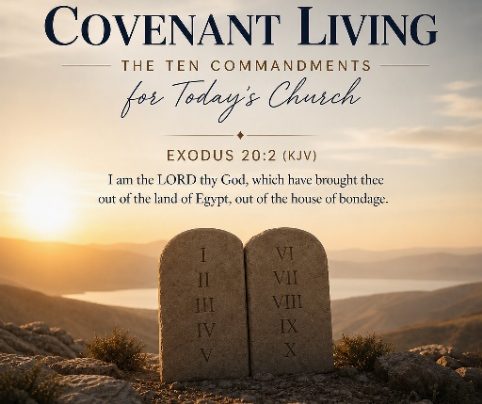
The opening lines of Exodus 20 are easy to rush past, but they are the doorway into everything that follows. Before God gives a single command, He gives a reminder — a rescue — a relationship.
“I am the LORD thy God, which have brought thee out of the land of Egypt, out of the house of bondage.” (Ex. 20:2)
That is where covenant living begins. Not with legalism. Not with pressure. Not with performance. With grace.
The Ten Commandments Begin With Rescue
Before God tells His people how to live, He tells them who He is. He anchors obedience in identity, relationship, and presence. He rescues first, then instructs. He frees, then forms.
As Morgan beautifully observed, God didn’t hand Israel a list of laws while they were still slaves, promising freedom if they obeyed. He brought them out — then taught them how to live free.
This matters for today’s church. We cannot understand the commandments unless we first understand the heart behind them.
God’s Law Reveals God’s Heart
When God speaks the commandments, He is not a distant judge handing down regulations. He begins with relationship:
“I am the LORD your God…”
Before He commands, He connects. The law flows out of His character — His holiness, His goodness, His desire for relationship.
- God’s holiness — Leviticus 11:45
His holiness is not cold; it is beautiful. The commandments show what holiness looks like in everyday life: worship, speech, relationships, priorities. - God’s goodness — Psalm 19:7–9
Every command protects something precious: worship, marriage, truth, life, community. - God’s covenant love — Exodus 20:2
The law is not a contract; it is a covenant. God says, “You belong to Me.”
The commandments are rooted in love — like a father whose rules preserve the joy of his children.
God’s Law Restores God’s People
Sin doesn’t just break rules — it breaks people. It fractures families, communities, identity. God’s law is His gracious blueprint for putting broken things back together.
- Reordering our lives — Psalm 119:105
God’s Word puts first things first. - Protecting us from self‑destruction — Psalm 119:9
Idolatry destroys worship.
Adultery destroys families.
Theft destroys trust.
Coveting destroys contentment. - Shaping a distinct people — Deuteronomy 10:13
God’s commands are “for your good.” Holiness is meant to make God’s people shine.
The commandments are not shackles — they are safeguards. They are part of God’s restoration project.
God’s Law Leads Us to God’s Son
The law reveals God’s standard — and our inability to meet it. It is a mirror that exposes our sin and a tutor that leads us to Christ.
- Shows our sin — Romans 3:20
- Shows our inability — Galatians 3:24
- Shows our Savior — Matthew 5:17
Jesus didn’t abolish the law — He fulfilled it. Perfectly. Sacrificially. Victoriously.
The commandments are not a ladder we climb to reach God; they are a spotlight showing our need for Jesus.
God’s Law Empowers God’s Mission
Obedience is never merely private — it is missional. A holy people display a holy God.
- Holiness as witness — 1 Peter 2:9–12
- Obedience that shines — Matthew 5:16
- Love as apologetic — John 13:35
The world sees God through God’s people.
The commandments are not God’s way of keeping people out — they are God’s way of bringing people close. They reveal His heart, His goodness, His holiness, His desire for relationship, and our need for Jesus.
Maybe your life feels out of order.
Maybe sin has broken something in you — your peace, your home, your confidence.
Maybe you’ve been trying to obey God without abiding in God.
Hear His voice again:
“I am the LORD your God, who brought you out…”
He is still the God who brings people out — out of bondage, shame, fear, sin, and the “Egypts” we create for ourselves.
Before we learn the commandments, let’s meet the God who gives them.
Before we talk about obedience, let’s return to relationship.
Before we walk in holiness, let’s rest in grace.


