Disciplines of the Godly: Obedience

Reflect on John 14:15 and the motivation, standard, and reality of loving obedience to Christ.

THE DISCIPLINES OF THE GODLY

Scripture

John 14:15 If ye love me, keep my commandments.

In the ancient world, the concept of a servant or a slave was universally tied to forced submission. Slaves wore heavy iron collars, worked under the constant threat of a whip, and obeyed solely because they had no choice. It was a prison of cold, rigid obligation.

But the ancient Hebrew law contained a beautiful, stunning exception found in the book of Exodus. If a servant reached the end of his required time of service, the law stated he was legally free to walk away. He could take his blanket, leave his master’s house, and go wherever he wanted. He had total cultural “freedom.” However, the law said that if that servant looked at his master and said, “I love my master, my wife, and my children; I will not go out free,” something remarkable happened. The master would take the servant to the doorpost of the house. There, in front of witnesses, the servant would willingly press his ear against the wood, and the master would pierce it through with an awl. From that day forward, that servant wore a distinct ring in his ear.

To a stranger passing by, that ear piercing looked like a symbol of slavery. But to everyone who knew the law, it was the ultimate badge of honor. It didn’t mean he had to obey; it meant he wanted to obey. His obedience was no longer driven by the fear of a whip, but by the weight of his love.

When many people hear the word discipline or obedience, they instantly think of rules, restriction, and rigid duty. We naturally resist being told what to do. In our modern culture, freedom is defined as doing whatever you want, whenever you want.

True biblical discipline is not forced legalism; it is willful obedience. It is the believer stepping up to the doorpost of the Savior’s house, looking at the scars in His hands, and saying, “Lord, you have set me free from sin and death, but I love you too much to ever walk away. Pierce my heart with your truth. I choose your boundaries over the world’s chaotic freedom.”

Biblical discipline isn’t a prison; it is a protection. True obedience in the Christian life is not a cold obligation, but the natural overflow of a loving heart.

We often try to measure our love for God by our emotions, our church attendance, or the songs we sing. But in our text today, Jesus gives us a very practical, tangible standard. He cuts through our emotional highs and points directly to our daily choices.

I. THE MOTIVATION FOR OBEDIENCE

Notice the precise order of Jesus’ words: “If ye love me, keep my commandments.” [KJV] He does not say, “Keep my commandments so that I will love you.” Every man-made religion teaches that you must obey in order to be accepted by God. Christianity turns this completely upside down: we are already fully accepted because of what Jesus did on the cross, and therefore we obey. Love is the engine; obedience is the vehicle.

Legalism tries to force external behavioral changes without transforming the heart. A person operating under a legalistic mindset obeys solely out of fear of punishment, a desire to look righteous to others, or a transactional attempt to earn blessings. Rules without relationship always lead to deep self-righteousness, quiet resentment, or eventual spiritual burnout.

Jesus knew we could never sustain this discipline in our own human strength. Immediately after giving this command, He says in verse 16, “And I will pray the Father, and he shall give you another Comforter, that he may abide with you for ever.” The Holy Spirit changes our “have to” into a “want to.” He provides the supernatural desire and the daily power to live a life that honors God.

II. THE STANDARD OF OBEDIENCE

God’s commandments are not designed to rob us of joy or ruin our lives. They are the manufacturer’s instruction manual for the human soul. Just as a loving parent tells a young child not to play in a busy street out of deep affection and protection, God sets moral boundaries for our ultimate good. As 1 John 5:3 explicitly declares, His commandments are not grievous.

When asked what the greatest commandment was, Jesus condensed the entire law into two absolute priorities: loving God with all our heart, soul, and mind, and loving our neighbors as ourselves (Matthew 22:37-40). Every specific moral instruction in Scripture flows from this double-sided foundation of love.

In John 13:34, just moments before our primary text, Jesus gives the supreme standard: “That ye love one another; as I have loved you.”

Our obedience is modeled entirely after His. Jesus didn’t just teach obedience; He lived it perfectly, submitting Himself entirely to the Father’s will, even unto the death of the cross.

If obedience is rooted in love and modeled by Christ, then the natural question becomes, ‘What does obedience actually look like in everyday life?’ Thankfully, the New Testament leaves us no room for confusion.

Jesus does not leave us guessing as to what a disciplined life looks like. The New Testament epistles consistently direct our obedience in three clear, practical areas:

  • Our Upward Obedience (Toward God):

The Command to Worship: Loving Him with all our heart, soul, mind, and strength, refusing to allow any modern idol to take His place (Matthew 22:37). The Command to Trust: Submitting our worries, plans, and finances to His sovereignty, actively resting in His provision instead of our own control (Proverbs 3:5-6, Matthew 6:33).

The Command to Study: Responsibly hiding His Word in our hearts so that our minds are continually renewed (John 8:31, Colossians 3:16).

  • Our Inward Obedience (Toward the Church):

The Command to Love One Another: Serving, forgiving, and bearing the burdens of our brothers and sisters in Christ, matching the sacrificial standard Jesus set for us (John 13:34, Ephesians 4:32).

The Command to Unity: Guarding the peace of the local body by refusing to engage in gossip, division, or self-exaltation (Philippians 2:3-4).

  • Our Outward Obedience (Toward the World):

The Command to Great Commission Living: Actively sharing the gospel of Jesus Christ and making disciples, starting right in our own communities (Matthew 28:19-20).

The Command to Holiness: Walking in moral purity and honesty, ensuring our speech, business practices, and conduct reflect Christ to an unbelieving world (1 Thessalonians 4:3-4, Matthew 5:16).

The Command to Submit to Authority: Honoring and obeying civil government and leaders, so long as it does not violate God’s higher law (Romans 13:1, Acts 5:29).

III. THE REALITY OF OBEDIENCE

Loving obedience is not always easy. Sometimes obedience costs comfort, popularity, opportunities, or even relationships. Yet every act of obedience declares that Christ is worth more than whatever we must surrender.

Obedience is the gateway to experiencing the presence of God in a deeper way. In John 14:21, Jesus promises that the one who keeps His commandments is the one who loves Him, adding, “and I will love him, and will manifest myself to him.”

When we choose to live in persistent, willful compromise, we cloud our own spiritual vision. But when we walk in simple obedience, Christ reveals Himself to our hearts with greater clarity and sweetness.

The enemy loves to convince believers that walking in strict obedience leads to a miserable, boring life. Yet, Jesus explicitly states that He shares these principles “that my joy might remain in you, and that your joy might be full” (John 15:11).

True, lasting joy is never found in the chaotic freedom of the world; it is found in the secure safety of God’s perfect boundaries.

Conclusion

Before we leave this passage, let me ask you a very simple question. Is there an area of your life where you know what Christ has said, but you have not obeyed? Is there forgiveness He has commanded that you refuse to give? Is there trust He has asked of you that you continue to withhold? Is there service He has called you to that you continue to avoid? Because obedience is not measured by what we know, but by what we do with what we know.

In the mid-18th century, Giuseppe crafted an exceptionally powerful violin. The virtuoso Niccolò later acquired it, nicknaming it “Il Cannone” for its explosive, soaring resonance.

Upon his death in 1840, Paganini bequeathed the instrument to his home city of Genoa, Italy, to be perpetually preserved. The city honored his wishes, placing it under strict security.

Over the decades, expert curators recognized that historic wooden instruments require meticulous maintenance and environmental control to prevent warping and degradation. Rather than keeping it completely silent, Genoa established a tradition allowing master musicians— including winners of the prestigious Premio Paganini competition—to periodically play it. This active, careful preservation ensures Il Cannone retains its legendary voice.

Church, this is exactly what happens when we treat the Christian life like a legalistic checklist. We think we are protecting ourselves by locking our lives behind a glass wall of rigid, forced duty. But rules without relationship will cause your soul to rot from the inside out. You will end up spiritually brittle, resentful, and exhausted.

Our obedience was never meant to be a cold museum display. We are the instrument, and Jesus is the Master Musician.

When we step out of the performance of legalism and step into willful obedience, we are simply placing our lives back into the scarred hands of the One who loves us.

Every time you obey Him; when you choose to forgive, when you choose to trust Him with your finances, when you choose to serve, it is like the Master drawing the bow across the strings of your heart.

It doesn’t mean your life will be free from friction. The bow causes friction! But it produces a beautiful, supernatural melody that the world desperately needs to hear.

Our time at the altar might look like a walk back to the doorpost. Not because we’re slaves, but because we love our Master. Not because we’re earning His favor, but because we’ve already received it.

For some, it will be a fresh look at the cross, seeing the staggering depth of His love.

For others, it will be a time to come before the Master, to rededicate yourself.

For all of us it will be the moment we choose to let our obedience become the overflow of a heart captivated by His grace.


Disciplines of the Godly: Meditation

Explore biblical meditation in Joshua 1:8 and Psalm 1, moving from knowledge of Scripture to a life shaped by obedience.

DISCIPLINES OF THE GODLY

Scripture

Joshua 1:8 This book of the law shall not depart out of thy mouth; but thou shalt meditate therein day and night, that thou mayest observe to do according to all that is written therein: for then thou shalt make thy way prosperous and then thou shalt have good success.

Psalm 1:2 But his delight is in the law of the LORD; and in his law doth he meditate day and night.

Imagine walking into a world-class art museum, standing in front of a masterpiece that took a legendary artist years to paint, glancing at it for three seconds, checking a box on a flyer, and rushing to the exit. It sounds absurd, yet this is exactly how many of us treat the living Word of the Almighty God. One of the quiet tragedies of modern Christianity is that we have become chronically hurried Bible readers. We skim paragraphs while listening to podcasts. We glance at a verse on a smartphone screen while sitting in traffic. We check off a daily reading plan chapter just to ease our conscience, and then we immediately move on.

But the Bible never promises a blessing to the reader who rushes; it only promises a blessing to the believer who lingers. We live in a culture that worships speed, but God forms spiritual depth in the slow lanes of life. Meditation is the vital discipline that slows the soul down long enough for eternal truth to sink deep into our spiritual fiber. It acts as the indispensable bridge between intellectual Bible study and actual, lived obedience. It is the precise mechanism where the Word moves from a cold concept in the mind into a burning conviction in the heart, and finally into real-world action.

Joshua 1:8 lays out this divine sequence with absolute clarity: we read the Word, we meditate on the Word, we obey the Word, and only then do we experience God’s blessing. This is not a shortcut; it is how God grows resilient, unshakable Christians.

I. The Meaning of Biblical Meditation

To understand what God is calling us to, we have to rescue the word “meditation” from modern culture. When the secular world talks about meditation, they mean Eastern meditation—a practice centered on emptying the mind, detachment, and looking inward to find truth. Biblical meditation is the exact opposite. It is not the emptying of the mind; it is the filling of the mind with the objective truth of God.

When Joshua commands us to meditate, he uses the rich Hebrew word hagah. In its ancient context, it literally means “to mutter, to chew, or to ponder.” Psalm 63:6 — “When I remember thee upon my bed, and meditate on thee in the night watches.” If you’ve ever watched a cow out in a pasture, you’ve seen a living illustration of hagah. A cow has a complex digestive system designed to squeeze every single ounce of nutrition out of what it eats. It swallows grass, brings it back up later, and chews on it again and again. It is a slow, repeated, and patient process. The cow draws out every drop of nourishment until that food is completely digested and integrated into its physical body.

That is precisely what biblical meditation looks like. It is chewing on a verse, swallowing it, bringing it back to mind hours later, and turning it over again and again. It is digesting the Word until it stops being words on a page and becomes part of your spiritual DNA. This is why Psalm 1 says the blessed man meditates “day and night.” This isn’t talking about a legalistic obligation to read Scripture 24 hours a day. It means creating a habit of the heart. It means that whether you are sitting at a desk, folding laundry, or driving down the highway, the truth of God is gently rolling around in your thoughts. Meditation isn’t a complicated theological science; it is simply the art of lingering.

II. The Mechanics of Meditation — Moving From Head to Heart

How does this actually look in the routine of a busy week? Joshua notes, “This book of the law shall not depart out of thy mouth.” It seems strange at first that meditation would involve the mouth instead of just the brain. But in the ancient world, people almost always read aloud. Meditation begins with physically speaking the Word—whispering it, repeating it, memorizing its cadences, and letting it echo in your own ears.

However, we must remember that meditation is never aimed at information alone. Satan knows the facts of Scripture better than any seminary professor, yet he is entirely unchanged by them. Joshua warns us of the true target: “…that thou mayest observe to do according to all that is written therein.” The goal of intellectual study is comprehension, but the goal of meditation is transformation. It moves truth down the longest eighteen inches in the world—the distance from the human brain to the human heart—stirring our affections and strengthening our will to obey.

To practice this every day, try using three simple, practical steps:

  • Isolate: You cannot meditate in the middle of a circus. You must deliberately step away from the digital noise and domestic chaos. Even if it is only for two quiet minutes in a parked car before walking into work, or a closed bedroom door early in the morning— give the Word room to breathe in your mind.
  • Interrogate: Treat the Scripture like an active conversation partner. Ask it direct questions. “What does this specific phrase show me about the character of God?” “What hidden flaw does this reveal about my own heart?” “Is there a heavy command here I am avoiding obeying?” “Is there a beautiful promise here I need to start believing?”
  • Incorporate: Finally, turn the text directly into prayer. Don’t just read about peace; pray, “Lord, make this peace real in my anxious heart today.” Don’t just read about forgiveness; pray, “Lord, give me the strength to extend this exact grace to my coworker tomorrow.” This is how abstract theology becomes a life-changing reality.

III. The Manifestation of Meditation — The Promised Reward

When we commit to this lifestyle, God attaches a profound, breathtaking promise to it. Joshua writes, “For then thou shalt make thy way prosperous, and then thou shalt have good success.” We must be careful not to view this through the distorted lens of modern prosperity theology. God is not promising that if you memorize Scripture, He will automatically clear your debts, buy you a mansion, or guarantee you a corporate promotion. This is spiritual prosperity. It means a life lived in perfect alignment with the sovereign will of God. It means experiencing a supernatural clarity in your daily decisions and a deep, unmovable peace that external circumstances cannot steal from you.

True success is not measured by the world’s standard of wealth, status, or applause. It is measured by God’s standard: the quiet ability to faithfully accomplish the eternal purposes He has called you to fulfill. Psalm 1 captures this beautifully by comparing the meditating believer to a robust tree planted deeply by rivers of water.

Notice that this tree is planted. It didn’t get there by accident. It was deliberately placed there by God, constantly nourished by an unseen water source, and made consistently fruitful for His glory. When the scorching heat waves of life hit, its leaves do not wither.

Isaiah 26:3 — “Thou wilt keep him in perfect peace, whose mind is stayed on thee.”

When seasons of absolute drought and tragedy come, its fruit does not fail. While the rest of the world panics and dries up during a crisis, the meditating believer stands tall, completely unshakeable, because their roots are drinking deeply from the endless river of God’s eternal truth.

Conclusion

The spiritual discipline of meditation is not a specialized calling reserved exclusively for monks in monasteries, scholars in ivory towers, or pastors in study rooms. It is a daily necessity designed for busy moms changing diapers, for auto mechanics working under cars, for teenagers navigating peer pressure, and for tired, weary saints just trying to make it through the week. It is for anyone who desires the living Word of God to dwell richly inside their everyday life.

If you will commit to read the Word, to deeply meditate on the Word, and to actively obey the Word, God Himself guarantees that your soul will prosper and you will find lasting success in His eternal kingdom. Let us step out of the frantic rush of this world. Let us become a people who choose to linger, finding our deepest, daily delight in the law of the Lord day and night.

Disciplines of the Godly: The Discipline of Study

Discover the purpose of biblical study, how Scripture shapes the Christian life, and practical habits for studying God’s Word.

DISCIPLINES OF THE GODLY

Scripture

Joshua 1:8 (KJV)

“This book of the law shall not depart out of thy mouth; but thou shalt meditate therein day and night, that thou mayest observe to do according to all that is written therein: for then thou shalt make thy way prosperous, and then thou shalt have good success.”

Nineteenth-century Swiss naturalist Louis Agassiz was famous for how he trained his students. On the first day, he handed a student a dead sunfish on a tin tray and said, “Look at it. By and by I will ask what you have seen.” After an hour, the student was bored. He knew it was a fish—it had scales, fins, and a tail. He left for lunch, came back, and looked more. Agassiz didn’t return until the next day. For three straight days, the student was forced to sit in silence and just look at the same fish.

By the third day, the student began noticing things he missed: how the scales overlapped, the exact shape of the teeth, the symmetry of the gill arches. He rushed to Agassiz, sketching details he hadn’t seen before. Agassiz smiled and said, “A fish is a wonderful thing, but most people never truly see it. Now, look at it for three more days.”

Most Christians treat Scripture like that student treated the fish in the first ten minutes. We skim it, say “Yep, it’s a fish,” and walk away. But the spiritual discipline of study is an intentional focused practice of engaging the mind with truth. For the believer they look primarily to scripture and the created world. To transform our habits of thought and conform our lives to God.

If prayer is communion with God, study is formation by God; it is the shaping of the mind so the heart can follow.

I. The purpose of this discipline, not singularly, but as a step in the process is for:

  • Transformation – Shifting your focus from mere information gathering to a life change, replacing destructive habits with life-giving truth.
  • Renewal of the mind – This discipline teaches believers to see things from God’s perspective and discern His will.
  • Humility – This discipline requires a teachable spirit, guarding against pride by submitting acquired knowledge to God.

II. The content of this discipline cannot really be limited, but let us consider three ways we study who God is.

  • Firstly, and most importantly, Scripture – The written word of God is the primary anchor for spiritual growth. 2 Timothy 3: 16 All scripture is given by inspiration of God, and is profitable for doctrine, for reproof, for correction, for instruction in righteousness: 17 That the man of God may be perfect, thoroughly furnished unto all good works. Some commentators feel that Paul was strictly writing this concerning the Old Testament, but Paul uses this wording to include what the apostles were teaching, preaching, and prophesying. David Guzik states, “he recognized that what God uniquely brought forth from the apostles and prophets in his time was also Scripture; it was also the God- breathed word of God. This included what he and others knew was emerging as the written form of the foundation of the apostles and prophets mentioned in Eph 2:20 And are built upon the foundation of the apostles and prophets, Jesus Christ himself being the chief corner stone…” This would fulfill the promise Jesus made that the Holy Spirit would speak to the apostles and lead them into all truth. Paul commanded the public congregational reading of his letters, as would be done with the Hebrew Scriptures (Col 4:16, 1Th 5:27). Paul called his own message the word of God (1Th 2:13). In 1Ti 5:18, Paul combined a quotation from the Old Testament, and some words of Jesus recorded in Luk 10:7 and he called both of them “Scripture.” Paul wasn’t the only one who thought this way. 2Pe 3:15 b-16 indicates the same idea, especially when Peter included Paul’s writings under the heading, Scriptures.
  • Secondly, the content of nature – Observing all that is in the physical world and the abilities given to man to create is a means of recognizing God’s handiwork. Understand that sin warps the human to create evil and wickedness, this is not from God, but the fact that man can create music, art, literature, and great buildings points to God The Creator of man. Beyond that we look the earth, galaxy, times, and seasons and we see God’s wisdom and fingerprints.

Psa 19:1 To the chief Musician, A Psalm of David. The heavens declare the glory of God; and the firmament sheweth his handywork.

Psa 19:2 Day unto day uttereth speech, and night unto night sheweth knowledge.

Psa 19:3 There is no speech nor language, where their voice is not heard. David Guzik writes, “David looked to the heavens – not the spiritual heaven where God is enthroned, but the heavens of the blue sky and the night sky – and he clearly saw the glory of God declared. The day sky and the night sky speak to us, and reveal knowledge about the glory, wisdom, and creative greatness of God. The glory of God in the visible heavens is for all to see; it is communicated to all mankind, no matter what their language.” The Apostle Paul in Romans 1, explains in verse 20 For the invisible things of him from the creation of the world are clearly seen, being understood by the things that are made, even his eternal power and Godhead; so that they are without excuse: “Should a man live underground, and there converse with the works of art and mechanism, and should afterwards be brought up into the open day, and see the several glories of the heaven and earth, he would immediately pronounce them the works of such a Being as we define God to be.” (Aristotle, cited in Spurgeon) Nature does not save, but it does speak; and what it plainly speaks is the glory of God.

  • Lastly, Christian literature – These must be utilized with discernment. With the understanding that these are not substitutes for God’s word. Not everything that says Christian is indeed Christian. However, when reading after these commentators, thinkers, and theologians there is an opportunity to expand your understanding of the scriptures and heart of God. A cautionary line to measure everything written by man is to verify it by the scriptures and as one preacher stated, “If 2,000 years of commentary agree on the explanation of the passage of scripture then it is a good indicator that they are correct and therefore can be trusted as having the correct insight of that scripture.”

III. To cultivate a deep habit of study, we will incorporate a mix of physical, mental, and spiritual habits that prepare the heart and mind.

a. Physical Posture:

  • Silence and Solitude – Intentionally placing yourself in an atmosphere free of distractions (no outside competing noise, no phone or tablet, etc.) this creates a space for deep concentration. (These disciplines we will explore later).
  • Sabbath keeping – Resting the mind from frantic daily activities so that the energy is there for the required deep, unhindered reading of the scriptures.

b. Spiritual Posture”

  • Prayer for illumination – Asking the Holy Ghost to guide you into all truth and reveal to you the true understanding of the scripture and the humility to apply it.
  • Meditation – intentionally pausing on a word, phrase, or verse for an extended period of time rather than rushing ahead.

c. Mental Engagement:

  • Annotation – marking pages, underlining key words or phrases, writing thoughts down that help you to engage into what is being read.
  • Journaling – Writing down summarization of the text, questions that arise for you to inquire about later, and personal application.
  • Memorization – Committing key passages to memory for easy access to them for the use of spiritual combat and personal pondering.

Quantity will fill your head with knowledge, but quality will cause that knowledge to become applied, creating wisdom; wisdom that is from God.

IV. We must know that this discipline is mandated;

1. The discipline of study is commanded by God according to Joshua Chapter one, verse 8.

2. The discipline of study is also taught by the apostles.

  • Colossians 3:16 – Paul says the word needs to dwell in the believer richly.
  • I Peter 2:2 – Peter compares the word to milk and meat that all believers are to crave…

3. The purpose of the discipline is:

  • Completing Peter’s thought from 1 Peter 2:2 …so they can grow up in their salvation.
  • In I Peter 3:15 – Again Peter admonishes that every Christian should always be prepared to give an answer to anyone who asks of the reason for the hope that they have in them. This requires knowing and studying the truth.
  • Ephesians 6:17 – We are told that the word of God is a weapon to combat the enemy.

Conclusion

Imagine a brilliant historian who spends 30 years writing the definitive biography of a great king. He studies the king’s letters, memorizes his speeches, catalogs his victories, and knows every detail of his daily routine. He knows more about the king than anyone alive. But one day, the historian walks into the palace, approaches the throne, and expects to sit down for dinner. The king looks at him and says, “Who are you? I have never met you.” The historian has massive amounts of information, but zero intimacy. This is the great danger of the unapplied mind. Satan knows theology; the demons study the scriptures and tremble. The goal of the discipline of study is not to become a walking encyclopedia of Bible trivia so you can win an argument. The goal is to know the Person behind the print. Don’t content yourself with knowing about God. Study His Word until your heart is fully formed by Him.

As we pray, may we make it a matter of great importance to ask God to give us a hunger for His word. A desire to be formed by it, led by it, and kept by it.

May God make us students of His Word so that prayer and study walk together in forming us into Christlikeness.

The Words That Shape Us

There is perhaps no clearer window into the condition of our hearts than the words that come out of our mouths. Jesus said, “Out of the abundance of the heart the mouth speaketh” (Matthew 12:34). What we say is not merely communication. It is revelation. Our speech reveals what is happening within us, what we truly value, and ultimately whom we represent.

As believers, we bear the name of Christ. Every conversation, every social media post, every joke, every criticism, every careless remark reflects not only on us but also on the Savior we profess to follow. Yet many things have become common in Christian culture that should never be common among Christians. Too often, gossip is disguised as concern, harshness is excused as honesty, complaining is accepted as normal, and careless words are treated as insignificant.

Scripture teaches otherwise.

The church needs a renewed commitment to biblical speech. We need a culture where believers understand that words matter, holiness matters, and the way we speak is part of our worship.

The Seriousness of Our Words

Jesus gave a sober warning:

“But I say unto you, That every idle word that men shall speak, they shall give account thereof in the day of judgment.” (Matthew 12:36)

Every idle word.

Not just the hateful words. Not just the public words. Not just the words spoken in anger. Every idle word.

That truth should cause each of us to examine our speech carefully. We live in a world where people speak without thinking, post without considering consequences, and react before exercising wisdom. Followers of Christ must be different.

Our words are seeds. They produce either life or destruction, healing or hurt, unity or division.

Things That Should Never Come Out of a Believer’s Mouth

Scripture clearly identifies forms of speech that have no place in the life of a Christian.

Gossip

Gossip spreads information that does not belong to us and often damages people who are not present to defend themselves. Even when the information is true, repeating it unnecessarily can still be sinful.

Slander

Slander attacks another person’s reputation through falsehood, exaggeration, or malicious accusation. Christians should be known as protectors of truth, not destroyers of character.

Lies and Deception

Whether through outright falsehood, exaggeration, manipulation, or half-truths, deception is contrary to the God of truth.

Corrupt Communication

Paul wrote:

“Let no corrupt communication proceed out of your mouth, but that which is good to the use of edifying…” (Ephesians 4:29)

Corrupt communication includes speech that is destructive, degrading, or spiritually harmful.

Filthy Language and Crude Joking

The world may celebrate vulgarity, but believers are called to purity. Speech that degrades holiness or treats sinful things casually should not characterize God’s people.

Angry Outbursts

Righteous conviction is one thing. Uncontrolled anger is another. Words spoken in rage often leave wounds that remain long after the anger passes.

Complaining and Grumbling

A complaining spirit reveals a heart that is focused more on frustration than gratitude. The people of Israel repeatedly fell into this trap, and believers must guard against it as well.

Flattery

Flattery is not encouragement. Encouragement is sincere. Flattery manipulates people for personal advantage.

Racial Slurs and Ethnic Mockery

Every human being bears the image of God. Christ died for people from every tribe, tongue, people, and nation. Speech that demeans others because of ethnicity, nationality, or skin color has no place in the mouth of a believer.

Self-Deprecating Speech

Humility and self-hatred are not the same thing.

While Christians should reject pride, we should also reject speech that continually tears down what God has made. We are sinners saved by grace, but we are also God’s workmanship. Constantly speaking as though we are worthless dishonors the God who is actively transforming us into the image of His Son.

Backbiting and Character Assassination

Speaking negatively about people behind their backs often reveals more about our hearts than theirs. Christians should be known for courageously addressing issues in a loving and direct way rather than criticizing people in their absence.

Things That Should Come Out of a Believer’s Mouth

If there are things we must stop saying, there are also things we should intentionally say.

Truth

Believers should be trustworthy people whose words can be believed.

Grace

Our words should carry the same grace we have received from Christ.

Encouragement

Many people are carrying burdens we know nothing about. A timely word of encouragement can strengthen a weary soul.

Thanksgiving

A grateful heart produces grateful speech. Instead of constant complaint, believers should cultivate a habit of expressing thanks to God and to others.

Wisdom

Not every thought needs to be spoken. Wisdom teaches us when to speak, what to say, and when silence is best.

Gentleness

Proverbs teaches that a soft answer turns away wrath. Gentleness is not weakness. It is strength under control.

Prayer

How much gossip would disappear if we spent more time praying about people than talking about them?

Praise

God’s goodness should be a frequent subject of our speech. We should be known as people who speak of His faithfulness, mercy, and grace.

Words That Build Up

Our speech should leave people stronger, not weaker; encouraged, not discouraged; pointed toward Christ, not away from Him.

Our Words Reflect Our Savior

The world is watching.

Whether we like it or not, many people will form impressions about Christianity based on the Christians they know personally. When believers engage in gossip, bitterness, harsh speech, prejudice, crude joking, and constant complaining, we communicate a distorted picture of Christ.

Our speech should make the beauty of Christ visible.

We are ambassadors of the King. Ambassadors do not represent themselves. They represent the one who sent them.

Before speaking, perhaps we should learn to ask:

  • Does this reflect the character of Christ?
  • Is it true?
  • Is it necessary?
  • Is it helpful?
  • Does it build up?
  • Would I be comfortable saying this if Jesus were physically standing beside me?

Because in reality, He is listening.

Showing Grace When Believers Fail

As important as holy speech is, we must remember another truth:

None of us has mastered the tongue.

Every believer has spoken carelessly. Every believer has said something they regret. Every believer is still growing in sanctification.

Therefore, if we are going to change the culture of Christian speech, we must also change the culture of how we respond when others fail.

Too often, Christians can be quick to condemn and slow to restore. Yet Scripture tells us:

“Brethren, if a man be overtaken in a fault, ye which are spiritual, restore such an one in the spirit of meekness…” (Galatians 6:1)

When a believer recognizes wrongdoing, confesses it, repents, and seeks to make things right, fellow believers should respond with grace.

That does not mean excusing sin.

It means reflecting the gospel.

Grace does not pretend wrong words were acceptable. Grace helps people recover from them. Grace calls for repentance while also extending forgiveness.

A healthy Christian culture should be one where people can admit failure without fear of permanent condemnation. When a brother or sister humbly acknowledges their sin and seeks reconciliation, we should be eager to forgive as Christ forgave us.

The church should be a place where truth and grace walk hand in hand.

We all need correction at times.

We all need mercy every day.

And we all depend completely upon the grace of God.

A Final Challenge

Imagine what would happen if believers truly committed themselves to honoring Christ with their speech.

Imagine churches where gossip was replaced with prayer.

Imagine families where criticism was replaced with encouragement.

Imagine social media feeds filled with truth, grace, and wisdom.

Imagine communities where believers were known not for their outrage, sarcasm, or arguments, but for words that brought life.

The culture of Christian speech can change.

It begins with each of us.

May our words be so shaped by Christ that people hear Him in us more than they hear us. And may we remember that every word we speak is an opportunity either to reflect our Savior or to misrepresent Him.

“Let the words of my mouth, and the meditation of my heart, be acceptable in thy sight, O LORD, my strength, and my redeemer.” (Psalm 19:14)

Related reading: For further reading on the character Christ calls His people to display, see Character of Kingdom Citizens by Thomas R. Hammond Jr.

YE ARE THE LIGHT

Matthew 5:14-16 KJV — Ye are the light of the world. A city that is set on an hill cannot be hid. Neither do men light a candle, and put it under a bushel, but on a candlestick; and it giveth light unto all that are in the house. Let your light so shine before men, that they may see your good works, and glorify your Father which is in heaven.

Jesus gives the Christian both a great compliment and a great responsibility when He says that we are the light of the world, because He claimed that title for Himself as He walked this earth (John 8:12 and John 9:5).

In being the light of the world; we are not only light-receivers, but also light-givers. We must have a greater concern than only ourselves, and we cannot live only to ourselves; we must have someone to shine to, and do so lovingly.

Light is needed because the world is in darkness, and if our Christianity imitates the darkness, we have nothing to show the world. To be effective we must seek and display the Christian distinctive. We can never affect the world for Jesus by becoming like the world.

The purpose of light is to illuminate and expose what is there. Therefore light must be exposed before it is of any use; if it is hidden it is no longer useful.

Jesus wants us to live out His light through our lives before the world.

Even as lamps are placed higher so their light can be more effective, we should look for ways to let our light shine in greater and broader ways.

The purpose in letting our light so shine by doing good works is so that others will glorify God, not ourselves.

Related reading: To explore what living as children of light means for today’s church, see To the Children of Light: Exposing Shadows, Restoring Truth by Thomas R. Hammond Jr.

THE HEART OF A BIBLICAL MOTHER

Before anyone else is awake, before the world notices, a mother is already ministering. Quiet prayers whispered over sleeping children. Tears no one sees. Sacrifices no one applauds. And yet heaven sees it all. 

The Bible portrays motherhood as a high calling, a divine blessing, and a crucial ministry focused on nurturing, teaching, and passing down faith. 

Paul David Tripp states, “Nothing is more important in your life than being one of God’s tools to form a human soul.” 

That’s what a biblical mother is, a woman God uses to shape a soul for eternity. 

Key characteristics of a biblical mother; 

  • Deep Faith: She trusts God’s guidance and sovereignty, finding strength in prayer. She trusts God when the path is unclear. 
  • Selfless Love: A selfless and nurturing love. She loves like Christ: steady, sacrificial, unconditional.   
  • Nurturing Faith: She actively teaches her children God’s Word, similar to Lois and Eunice in [2 Timothy 1:5], she plants Scripture in her children. 
  • Wisdom and Kindness: She “opens her mouth with wisdom, and on her tongue is the law of kindness” ([Proverbs 31:26]). Her words heal, guide, and build up. 
  • Sacrifice: Willing to put her children’s needs above her own. She gives when no one sees and keeps giving when she’s tired. 
  • Prayerful: Her heart is centered on seeking wisdom and praying for her children. Her knees bent in prayer, shape her children more than her hands ever will. 

And God, in His kindness, didn’t leave us without examples. He gave us mothers in Scripture whose lives preach louder than any sermon. 

Hannah: The Mother Who Prayed When Her Heart Was Breaking 

  • She experienced immense emotional pain. 
  • She persevered in intense prayer. 
  • She held a divinely appointed promise. That was made to her and by her. 
  • She praised the Lord through her obedience. 

And many mothers today know what it is to pray through pain, to trust God with what they cannot fix. 

Mary: The Mother Who Surrendered to God’s Calling. 

  • She obeyed despite the ridicule that she knew would come. 
  • She remained humble while fulfilling God’s call. 
  • She found and exhibited great joy in God’s plan. 

And every mother knows the weight of surrender — trusting God with a future she cannot control. 

The Canaanite Mother: The Mother Who Refused to Give Up 

  • She came boldly unto Christ who could intervene in her situation. 
  • She maintained faith in Him despite that she was undeserving of the least of His blessings. 
  • She fiercely loved her daughter, enough to remain persistent until an answer came. 

And mothers today still fight for their children in prayer, refusing to quit until Jesus answers. 

And the God who strengthened Hannah, who favored Mary, who answered the Canaanite mother, He is the same God who strengthens you today.  

Mothers, your prayers matter. Your tears matter. Your faith matters. Your labor in the Lord is not in vain. 

GOD SEES THE HEART

In Scripture, “God knows the heart” is never a free pass

When the Bible says God knows the heart, it’s usually in contexts like:

– Judgment (1 Samuel 16:7; Jeremiah 17:10)

– Exposure of hidden motives (Hebrews 4:13)

– Condemnation of hypocrisy (Luke 16:15)

– A call to repentance (Psalm 139:23–24)

The biblical message is:

“God knows your heart—and that’s exactly why you should fear Him, repent, and obey.”

It is never:

“God knows your heart—so you’re fine doing whatever you want.”

“God and I have an understanding” is spiritual self-deception

That phrase is basically the modern version of Israel saying:

> “We will walk after our own devices, and we will every one do the imagination of his evil heart.” (Jeremiah 18:12)

People who say “God and I have an understanding” are really saying:

– “I know what God says, but I’m choosing my own path.”

– “I want the comfort of religion without the cost of obedience.”

– “I want God’s blessing without God’s boundaries.”

But Scripture is unambiguous:

God has never made a private deal with anyone that contradicts His revealed will.

Not once.

Every covenant God ever made was:

– Initiated by Him

– Defined by Him

– Bound by His character

– Consistent with His Word

God does not negotiate sin.

He does not tailor holiness to personal preference.

He does not rewrite righteousness to fit someone’s lifestyle.

God knows the heart—and the heart is the problem.

Jeremiah 17:9–10

Matthew 15:19

Romans 3:10–18

The heart is not a justification; it’s the indictment.

If anything, “God knows my heart” should make a person tremble, not relax.

What people mean is: “I want God on my terms.”

And that’s the oldest sin in the book.

Adam and Eve wanted:

– God’s presence

– God’s blessing

– God’s garden

…but their own authority.

Modern Christians often want:

– God’s forgiveness

– God’s protection

– God’s comfort

…but their own lifestyle.

It’s the same rebellion with a churchy vocabulary.

When people use these phrases, they’re not just avoiding obedience—they’re avoiding transformation. They’re insulating themselves from conviction. They’re creating a false peace.

And false peace is more dangerous than open rebellion because it feels spiritual while being spiritually deadly.

LET THIS MIND BE IN YOU…

Paul says, “Let this mind be in you, which was also in Christ Jesus” (Philippians 2:5), he isn’t talking about a single attitude. He’s describing the entire inner posture of Christ; the way He thought, chose, valued, and responded. Scripture gives us a surprisingly clear picture of what that “mind” looks like.

1. A Mind of Humility (Philippians 2:6–8)

Christ “made Himself of no reputation.”

He willingly laid aside His rights, His status, His glory.

What this means for us:

– We stop fighting for recognition.

– We choose servanthood over status.

– We embrace God’s will over personal comfort.

2. A Mind of Obedience (Philippians 2:8)

Jesus was “obedient unto death.”

Obedience wasn’t an action — it was His mindset.

What this means for us:

– Obedience becomes our default posture, not an occasional act.

– We obey even when it costs us.

– We trust the Father’s wisdom above our own.

3. A Mind of Compassion (Matthew 9:36)

“When He saw the multitudes, He was moved with compassion.”

What this means for us:

– We see people through God’s eyes.

– We respond to need instead of retreating from it.

– Compassion becomes a reflex, not a reaction.

4. A Mind Set on the Father’s Will (John 4:34; John 6:38)

“My meat is to do the will of Him that sent Me.”

“I came… not to do My own will.”

What this means for us:

– God’s will becomes our sustenance.

– We stop living by impulse and start living by assignment.

– We measure success by faithfulness, not outcomes.

5. A Mind of Meekness and Gentleness (Matthew 11:29)

“Learn of Me; for I am meek and lowly in heart.”

What this means for us:

– Strength under control.

– Responding gently even when provoked.

– Being approachable, teachable, and peaceable.

6. A Mind Anchored in Truth (John 17:17; Matthew 4:4)

Jesus lived by the Word, quoted the Word, trusted the Word.

What this means for us:

– Scripture becomes our filter for decisions.

– We reject lies, fear, and worldly thinking.

– We cultivate a mind renewed by truth (Romans 12:2).

7. A Mind of Forgiveness (Luke 23:34)

“Father, forgive them…”

What this means for us:

– We release offenses quickly.

– We refuse bitterness.

– We imitate the mercy we’ve received.

8. A Mind Focused on Others (Philippians 2:3–4)

“Look not every man on his own things…”

What this means for us:

– We shift from self-centered to others-centered.

– We serve without expecting return.

– We value people above convenience.

If God should go on STRIKE

How good it is that God above has never gone on strike,

Because he was not treated fair in things he didn’t like,

If only once he’d given up and said, “That’s it, I’m through!

“I’ve had enough of those on earth, so this is what I’ll do.

“I’ll give my orders to the sun — cut off the heat supply!

“And to the moon — give no more light, and run the oceans dry.

“Then just to make things really tough and put the pressure on,

“Turn off the vital oxygen till every breath is gone!”

You know he would be justified, if fairness was the game,

For no one has been more abused or met with more disdain

Than God, and yet he carries on, supplying you and me

With all the favors of his grace, and everything for free.

Men say they want a better deal, and so on strike they go,

But what a deal we’ve given God to whom all things we owe.

We don’t care whom we hurt to gain the things we like;

But what a mess we’d all be in, if God should go on strike.


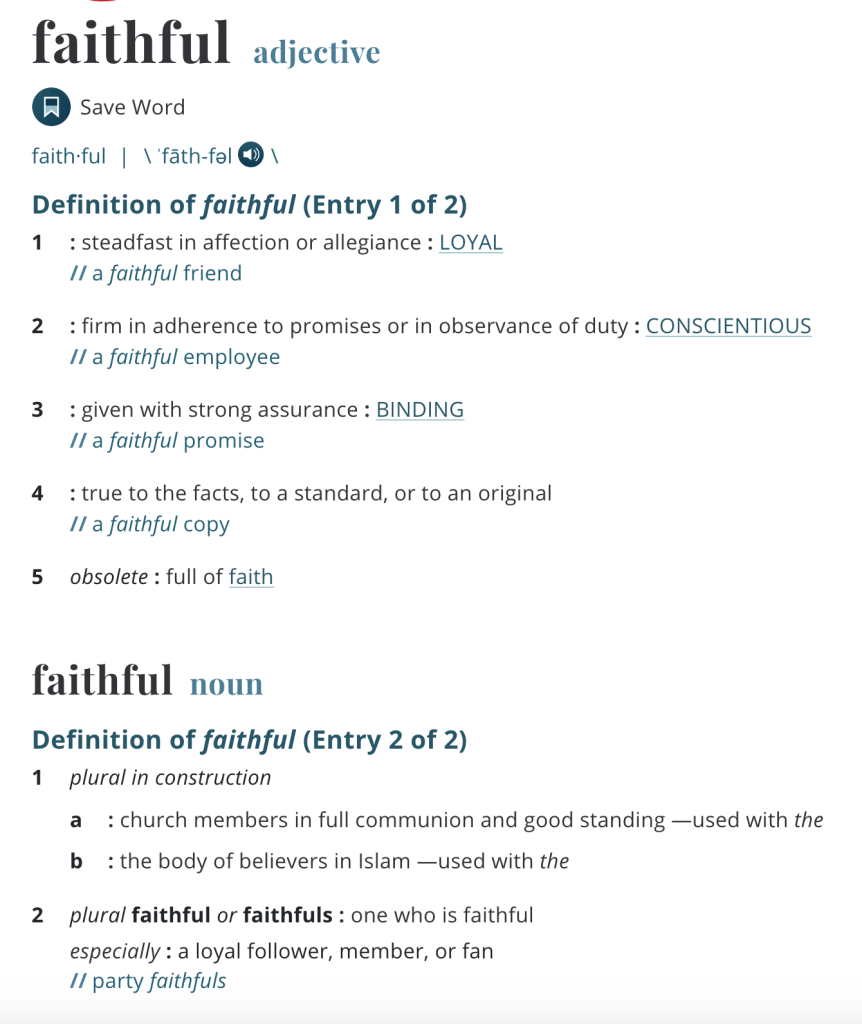
This poem is a stirring reminder that God is ever faithful….even when we are not.

Lam 3:23  They are new every morning: great is thy faithfulness.

Lam 3:24  The LORD is my portion, saith my soul; therefore will I hope in him.

Lam 3:25  The LORD is good unto them that wait for him, to the soul that seeketh him.

The Lord is good and can be trusted!

FAITHFUL, STEADFAST, DEVOTED.

What causes a man or a woman to remain steadfast, faithful, and devoted?At its very core is a Person, not a principle. But that Person works in several deep, interlocking ways that explain why some men and women endure when others drift.

1. A continual return to the Cross

Steadfast believers don’t “move on” from the gospel. They revisit it. They rehearse it.

They remember.

– They remember what they were without Him; lost, dead, blind, enslaved. – They remember what they are with Him; redeemed, adopted, cleansed, empowered.

This rhythm of remembrance keeps the heart soft, grateful, and anchored. It’s why Paul repeatedly says, “I put you in remembrance…” and why Jesus gave the church communion: “Do this in remembrance of Me.”

The Cross is not just the starting line; it is the sustaining power.

2. A deep awareness of His faithfulness

People remain faithful because they are overwhelmed by His faithfulness.

– He keeps His promises.

– He finishes what He starts.

– He holds them when they cannot hold themselves.

– He proves Himself again and again in the quiet places of life.Faithfulness grows in the soil of being faithfully loved.

3. A calling that is not self‑Generated

A true call of God is not a hobby, a preference, or a phase. It is a divine assignment that grips the soul.

Those who endure do so because:

– They didn’t call themselves.

– They didn’t choose the mission; the mission chose them.

– They know they will answer to God for it.

When the call is from God, quitting feels impossible, not because of pride, but because of conviction.

4. A love for Christ that outweighs the cost

Every long‑term servant of God eventually discovers that ministry often gives little immediate return:

– Time poured out

– Energy drained

– Emotions stretched

– Finances sacrificed

– Recognition absent

And yet they stay. Why? Because love makes sacrifice feel like worship, not waste. Jesus becomes the treasure that makes every other cost feel small.

5. A vision of eternity that redefines “reward”

Steadfast believers are not living for applause here.

They are living for:

– “Well done, thou good and faithful servant.”

– Crowns that do not fade.

– Souls that will stand in glory because they were faithful.

– A kingdom that cannot be shaken.Eternal vision produces earthly endurance.

6. The empowering presence of the Holy Spirit

No one remains steadfast by grit alone. The Spirit strengthens what human resolve cannot sustain.

He:

– Renews the inner man

– Rekindles passion

– Convicts, comforts, and corrects

– Produces fruit that human effort cannot manufacture

Steadfastness is not a personality trait—it is a work of the Spirit.

7. A gratitude that never grows old

Gratitude is fuel. Gratitude is fire. Gratitude is glue.A grateful believer is a steadfast believer.

#FollowerofChrist#faithfulness#Steadfastness#Devotion#gratitude#KingdomOfGod